How Peptides Are Made: Solid Phase Synthesis, Purification, and Quality Control
Understanding how peptides are manufactured helps researchers evaluate quality. This guide covers solid phase peptide synthesis, HPLC purification, lyophilization, and the quality control steps that determine the final product you receive.
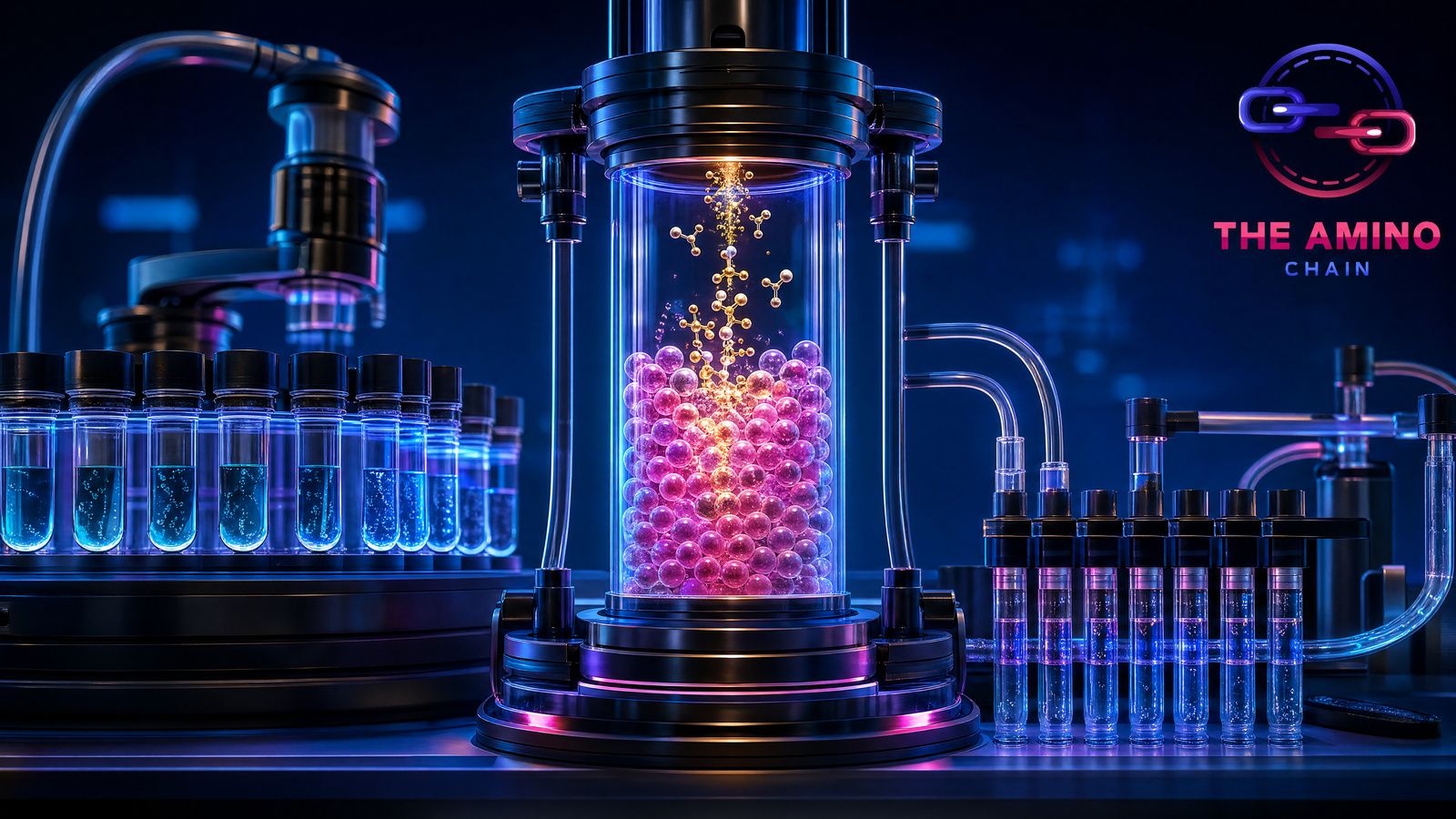
Every research peptide starts as a sequence of instructions — a list of amino acids in a specific order. Turning that sequence into a physical vial of lyophilized powder requires a sophisticated manufacturing process involving automated chemistry, high-performance purification, careful freeze-drying, and rigorous quality control. Understanding this process helps researchers evaluate supplier quality and interpret Certificate of Analysis documents more effectively.
Solid Phase Peptide Synthesis (SPPS)
The dominant method for manufacturing research peptides is Solid Phase Peptide Synthesis, developed by Robert Bruce Merrifield in 1963 — work that earned him the Nobel Prize in Chemistry in 1984. The fundamental principle is elegant: the peptide is built amino acid by amino acid while attached to an insoluble solid support (resin bead), allowing unreacted reagents and byproducts to be washed away after each step.
The process begins with the first amino acid (corresponding to the C-terminus of the final peptide) attached to a resin bead through a chemical linker. Each subsequent amino acid is added through a coupling reaction that forms a new peptide bond. After coupling, the protecting group on the newly added amino acid is removed (deprotection), exposing the reactive amine for the next coupling cycle.
Modern automated peptide synthesizers can complete each coupling cycle in 30-60 minutes, meaning a 15-amino acid peptide like BPC-157 can be synthesized in approximately 8-15 hours. Longer peptides take proportionally longer and present greater challenges — coupling efficiency must be very high (typically greater than 99% per step) because even small inefficiencies compound over many cycles.
The Coupling Efficiency Problem
If each coupling step has 99% efficiency, the theoretical yield of a 15-amino acid peptide is 0.99^14 = 87% (the first amino acid is pre-attached). For a 40-amino acid peptide, the yield drops to 0.99^39 = 67%. At 98% efficiency per step, a 40-amino acid peptide would yield only 0.98^39 = 45%. This exponential relationship between step efficiency and final yield is why longer peptides are more expensive and why coupling chemistry optimization is critical.
Modern coupling reagents and synthesis protocols achieve individual step efficiencies of 99.5% or higher for most amino acid combinations. However, certain sequences — particularly those involving sterically hindered amino acids or aggregation-prone stretches — can cause "difficult couplings" that require specialized chemistry.
Cleavage and Deprotection
After the complete peptide sequence has been assembled on the resin, two final chemical steps are needed. First, the side-chain protecting groups (which prevent unwanted reactions during synthesis) must be removed. Second, the peptide must be cleaved from the resin. Both steps are typically accomplished simultaneously using a cocktail of trifluoroacetic acid (TFA) and scavenger reagents that capture reactive cations released during deprotection.
The crude product from cleavage contains the target peptide along with deletion sequences (peptides missing one or more amino acids), truncated sequences, and various chemical byproducts. This crude material typically has 60-85% purity — far below the 99%+ specification required for research use. Purification is essential.
HPLC Purification
High-Performance Liquid Chromatography (HPLC) is the workhorse purification method for research peptides. Reversed-phase HPLC separates peptides based on their hydrophobicity — the target peptide elutes from the column at a specific time point (retention time) that differs from its impurities, allowing collection of the pure fraction.
Preparative HPLC (using large columns for scale purification) can achieve purities of 95-99%+ in a single pass for most peptides. The fractions containing pure peptide are collected and pooled, while impurity-containing fractions are discarded. The trade-off is yield — achieving higher purity means accepting a narrower collection window and losing some product in borderline fractions.
Lyophilization (Freeze-Drying)
After purification, the peptide is in an HPLC solvent mixture (typically acetonitrile and water with TFA). This solution must be converted to a dry powder for stability and storage. Lyophilization — freeze-drying — accomplishes this by freezing the solution and then sublimating the frozen solvent under vacuum (converting ice directly to vapor without passing through a liquid phase).
The result is a white to off-white fluffy powder (the "cake" visible in peptide vials) that is stable for long-term storage at -20°C. The lyophilized form has dramatically better stability than the solution form because degradation reactions (hydrolysis, deamidation, oxidation) are greatly slowed in the absence of water.
Quality Control Testing
Reputable manufacturers perform multiple quality control tests on every batch. Analytical HPLC confirms purity by running the finished product through an analytical column and measuring the percentage of the main peak relative to total UV-absorbing material. Mass spectrometry confirms identity by measuring the molecular weight and comparing it to the theoretical value for the target sequence. Amino acid analysis can confirm the composition and ratio of amino acids. And endotoxin testing ensures the product is free of bacterial contamination.
These results are documented on the Certificate of Analysis (COA) that should accompany every research peptide purchase. Understanding the COA — what each test means, what values are acceptable, and what red flags to look for — is essential for evaluating peptide quality.