PEGylated Peptides: How Polyethylene Glycol Modification Extends Half-Life and Changes Pharmacology
PEGylation is the most widely used peptide modification strategy in pharmaceutical research. Published data on how PEG attachment extends half-life, alters distribution, and changes biological activity explains why many modern peptides use this approach.
The biggest pharmacological limitation of peptides is their short half-life — most unmodified peptides survive only minutes in the bloodstream before enzymatic degradation clears them. PEGylation — the covalent attachment of polyethylene glycol (PEG) chains to peptide molecules — is the most widely used strategy for extending peptide half-life. Published research on PEGylated peptides spans nearly four decades, and the technology has enabled the development of once-weekly and even once-monthly peptide therapeutics from compounds that would otherwise require multiple daily injections.
What is PEG?
Polyethylene glycol is a synthetic, water-soluble polymer consisting of repeating ethylene oxide units: -(CH2CH2O)n-. PEG molecules come in various molecular weights, from small (2 kDa) to large (40 kDa or more). The polymer is non-toxic, non-immunogenic, and FDA-approved for use in pharmaceuticals, cosmetics, and food products. When attached to a peptide, PEG creates a hydrophilic shield around the molecule that dramatically alters its pharmacological properties.
How PEGylation Extends Half-Life
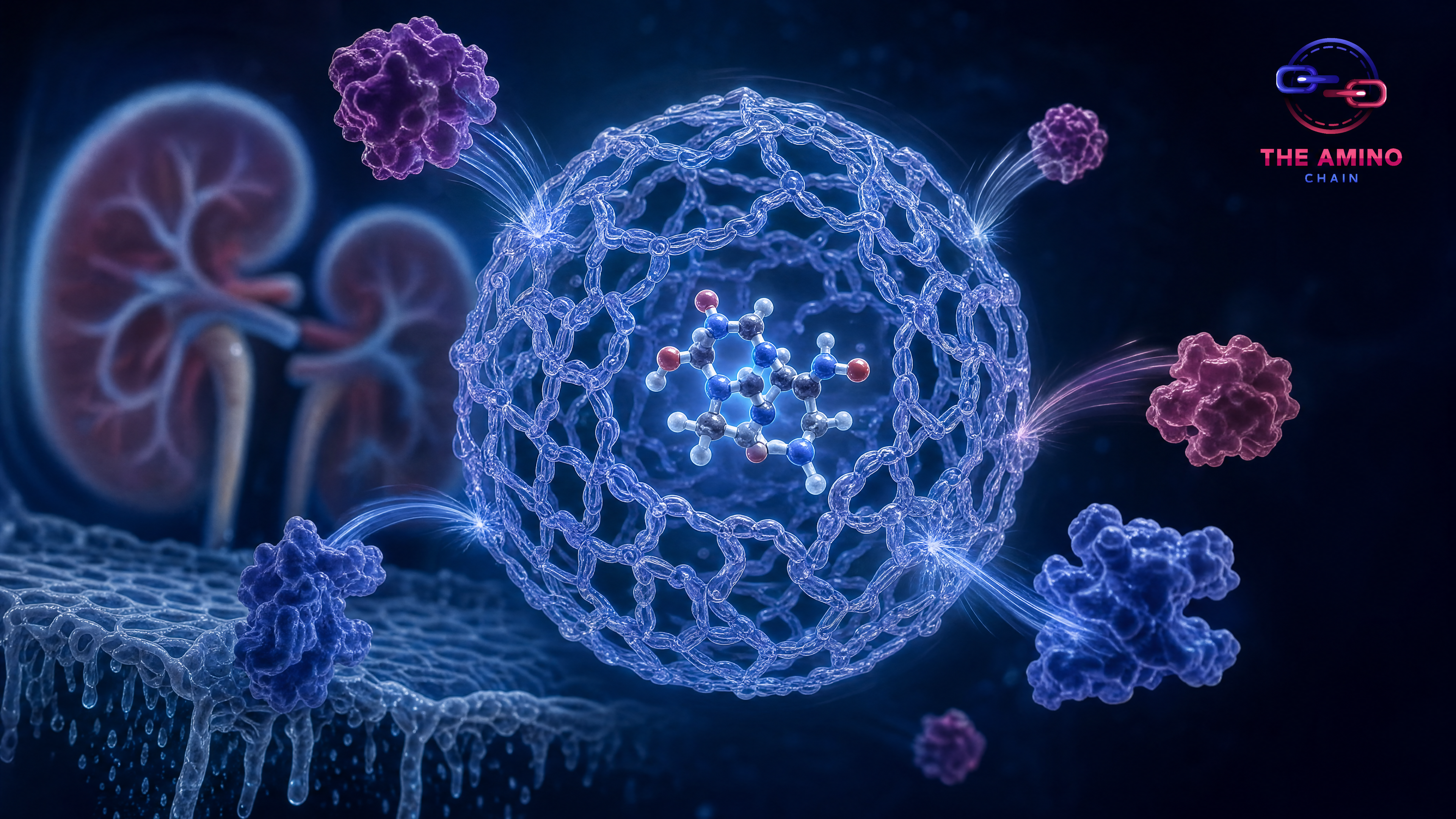
PEGylation extends peptide half-life through three complementary mechanisms. First, steric shielding: the PEG chain physically shields the peptide from proteolytic enzymes, preventing them from accessing and cleaving peptide bonds. Published research showed even modest PEG chains (5 kDa) significantly reduce protease susceptibility.
Second, reduced renal clearance: the kidneys filter molecules primarily by size. Unmodified peptides are small enough (typically 1-5 kDa) to pass freely through glomerular filtration and be excreted in urine. PEGylation increases the hydrodynamic radius of the peptide-PEG conjugate beyond the glomerular filtration threshold (approximately 70 kDa effective size for a 40 kDa PEG), dramatically reducing renal clearance.
Third, reduced immunogenicity: PEG's hydrophilic shell can mask immunogenic epitopes on the peptide surface, reducing antibody recognition and immune-mediated clearance.
The Size-Activity Trade-off
PEGylation involves a fundamental trade-off: larger PEG chains provide greater half-life extension but can reduce biological activity by sterically hindering receptor binding. Published research showed that site-specific PEGylation — attaching PEG at a position away from the receptor-binding domain — minimizes activity loss while maintaining the pharmacokinetic benefits. Random PEGylation (attachment at multiple possible sites) often produces heterogeneous conjugates with variable activity.
Modern PEGylation strategies use site-specific chemistry: cysteine-selective PEG reagents, non-natural amino acid incorporation for click chemistry attachment, or enzymatic conjugation at specific sites. These approaches produce homogeneous conjugates with defined PEG attachment points and predictable activity retention.
Examples in Peptide Research
PEG-MGF (PEGylated Mechano Growth Factor) uses PEGylation to extend the 24-amino acid E domain peptide's half-life from minutes to days. CJC-1295 with DAC uses a Drug Affinity Complex (a form of albumin-binding modification conceptually similar to PEGylation) to extend GHRH analog half-life to 6-8 days. Many pharmaceutical peptides in clinical development use PEGylation or related strategies (fatty acid conjugation, Fc fusion, albumin binding) to achieve practical dosing intervals.
Limitations of PEGylation
Published research has identified several limitations. Anti-PEG antibodies can develop with repeated administration, accelerating clearance of PEGylated molecules over time. PEG accumulates in tissues with chronic use — the long-term consequences of tissue PEG deposition are still being evaluated. And PEGylation adds significant manufacturing complexity and cost. Some next-generation approaches (XTEN fusion, albumin fusion, PASylation) are being explored as alternatives that provide similar half-life extension without PEG's limitations.
Relevance for Research Peptides
For researchers, understanding PEGylation explains why different forms of the same peptide (PEGylated vs non-PEGylated) may have dramatically different dosing requirements, onset times, and duration of effects. A PEGylated peptide administered at the same dose and frequency as its non-PEGylated counterpart may produce very different biological outcomes — higher sustained levels with the PEGylated form, higher peak levels with the non-PEGylated form. Matching the pharmacokinetic profile to the biological question is essential for meaningful research design.