Peptide Amino Acid Composition: What's in BPC-157, TB-500, and Other Research Peptides
Every peptide is a specific sequence of amino acids. This guide breaks down the amino acid composition of popular research peptides and explains why sequence matters for function, stability, and solubility.
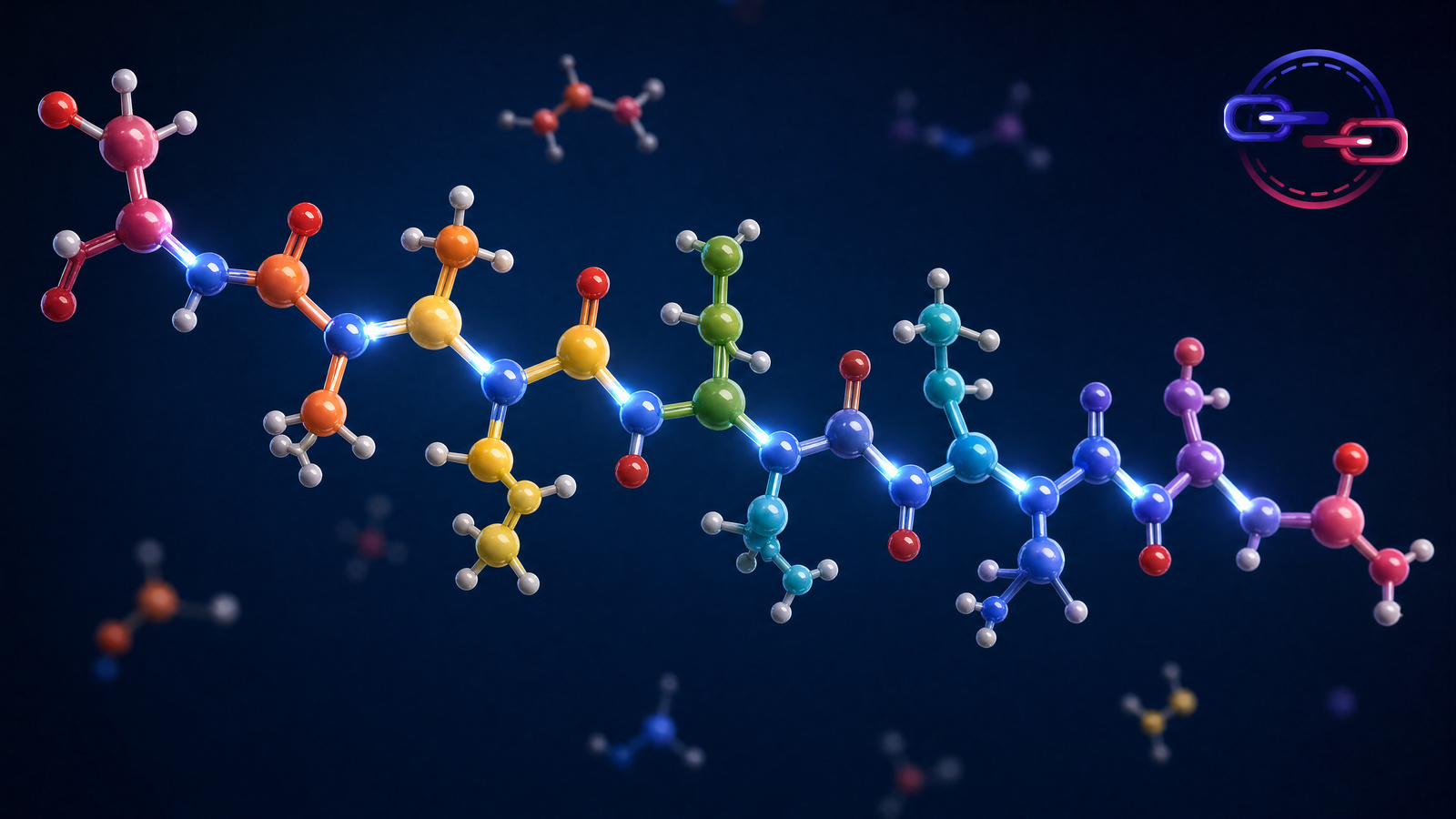
A peptide is defined by its amino acid sequence — the specific order of amino acid building blocks connected by peptide bonds. This sequence determines everything about the peptide's behavior: its three-dimensional structure, receptor binding properties, stability, solubility, and biological activity. Understanding the amino acid composition of research peptides provides insight into why they function the way they do and why small sequence changes can dramatically alter biological effects.
The 20 Amino Acid Building Blocks
All natural peptides are built from 20 standard amino acids, each with a unique side chain that gives it specific chemical properties. Some side chains are hydrophobic (water-repelling), some are hydrophilic (water-attracting), some carry positive or negative charges at physiological pH, and some have special structural properties. The sequence in which these amino acids are arranged determines the peptide's shape and function.
The amino acids are abbreviated using single-letter or three-letter codes. For example, glycine = G (Gly), alanine = A (Ala), leucine = L (Leu), glutamic acid = E (Glu), and lysine = K (Lys). These codes are used to write peptide sequences in a compact format.
BPC-157: A 15-Amino Acid Sequence
BPC-157 (Body Protection Compound-157) consists of 15 amino acids with the sequence: Gly-Glu-Pro-Pro-Pro-Gly-Lys-Pro-Ala-Asp-Asp-Ala-Gly-Leu-Val. Several features of this sequence are biologically significant.
The abundance of proline residues (4 out of 15 amino acids) gives BPC-157 unusual structural rigidity. Proline's cyclic side chain restricts the backbone flexibility of the peptide chain, creating characteristic "kinks" in the structure. This proline-rich composition may contribute to BPC-157's remarkable stability in gastric acid — a property unusual for peptides, which are typically degraded rapidly in the stomach.
The two aspartic acid residues and one glutamic acid contribute negative charges at physiological pH, while the single lysine provides a positive charge. This charge distribution influences the peptide's solubility (it dissolves readily in aqueous solutions) and its interactions with charged regions on receptor proteins and cell membranes.
BPC-157's molecular weight is approximately 1419 Da — relatively small for a bioactive peptide. This small size, combined with its stability and aqueous solubility, contributes to its versatility as a research compound.
TB-500: The Actin-Binding Sequence
TB-500 is a synthetic version of the 43-amino acid active region of Thymosin Beta-4, a naturally occurring 44-amino acid peptide. The key functional domain within TB-500 is the actin-binding motif: Lys-Leu-Lys-Lys-Thr-Glu-Thr (LKKTET), located at positions 17-23 of the sequence.
This LKKTET sequence is the molecular basis for TB-500's primary mechanism of action — sequestering monomeric G-actin to regulate actin polymerization and cell migration. The three consecutive lysine residues create a positively charged surface that interacts with negatively charged regions on actin monomers, preventing premature polymerization and maintaining a pool of actin available for rapid cytoskeletal reorganization.
TB-500's molecular weight is approximately 4963 Da, making it significantly larger than BPC-157. This larger size means TB-500 is more susceptible to enzymatic degradation and has different pharmacokinetic properties.
GHK-Cu: The Simplest Bioactive Peptide
GHK-Cu is a tripeptide — just three amino acids: Gly-His-Lys, complexed with a copper(II) ion. Its molecular weight is approximately 403 Da (peptide alone) or 467 Da (with copper). This makes it one of the smallest biologically active peptides known.
The histidine residue is critical for copper binding — its imidazole side chain provides one of the coordination sites for the copper ion, along with the terminal amine of glycine and the peptide bond nitrogen. This specific arrangement creates a high-affinity copper binding site that delivers copper to enzymes like superoxide dismutase and lysyl oxidase.
Despite having only three amino acids, GHK-Cu affects the expression of over 4,000 genes — approximately 6% of the human genome. This disproportionate gene modulatory effect relative to its small size suggests that GHK-Cu acts as a master regulatory signal rather than a simple enzyme substrate.
Why Sequence Matters: The Structure-Activity Relationship
Changing even a single amino acid in a peptide sequence can dramatically alter its biological activity. This principle — the structure-activity relationship (SAR) — is fundamental to peptide pharmacology. For example, replacing the lysine in GHK with another amino acid reduces copper binding affinity and diminishes biological activity. Similarly, modifications to BPC-157's proline-rich core region affect its acid stability and gastroprotective properties.
Pharmaceutical peptide engineering exploits SAR by making deliberate sequence modifications to enhance specific properties — improving receptor selectivity, increasing metabolic stability, or extending half-life. The fatty acid conjugation strategy used in long-acting incretin peptides like retatrutide and tirzepatide is an example of chemical modification (rather than sequence change) used to extend circulating half-life.
Amino Acid Composition and Solubility
A peptide's amino acid composition directly determines its solubility. Peptides with many charged residues (lysine, arginine, aspartic acid, glutamic acid) are generally water-soluble. Peptides with many hydrophobic residues (leucine, isoleucine, valine, phenylalanine) may require organic co-solvents like DMSO for dissolution. Understanding the amino acid composition helps predict reconstitution behavior and choose appropriate solvents.
Amino Acid Composition and Stability
Certain amino acids are chemically vulnerable to degradation. Methionine is susceptible to oxidation, tryptophan is sensitive to light-induced damage, asparagine can undergo deamidation, and cysteine residues can form unwanted disulfide bonds. Knowing which vulnerable amino acids are present in a peptide guides storage and handling decisions — peptides containing methionine or tryptophan need stricter protection from oxidation and light.