How Peptide Bonds Form: The Chemistry of Amino Acid Linkage, Condensation Reactions, and Bond Properties
Peptide bond formation is the fundamental chemical reaction that creates every peptide and protein. This guide explains the condensation reaction, bond geometry, resonance structure, and why peptide bonds are remarkably stable.
Every research peptide — from the 3-amino acid GHK-Cu to the 43-amino acid TB-500 — is held together by peptide bonds. Understanding these bonds isn't just academic chemistry: peptide bond properties determine a compound's stability, susceptibility to enzymatic degradation, and three-dimensional structure. This article explains how peptide bonds form, what makes them chemically special, and why this chemistry matters for researchers working with peptides in the laboratory.
The Condensation Reaction
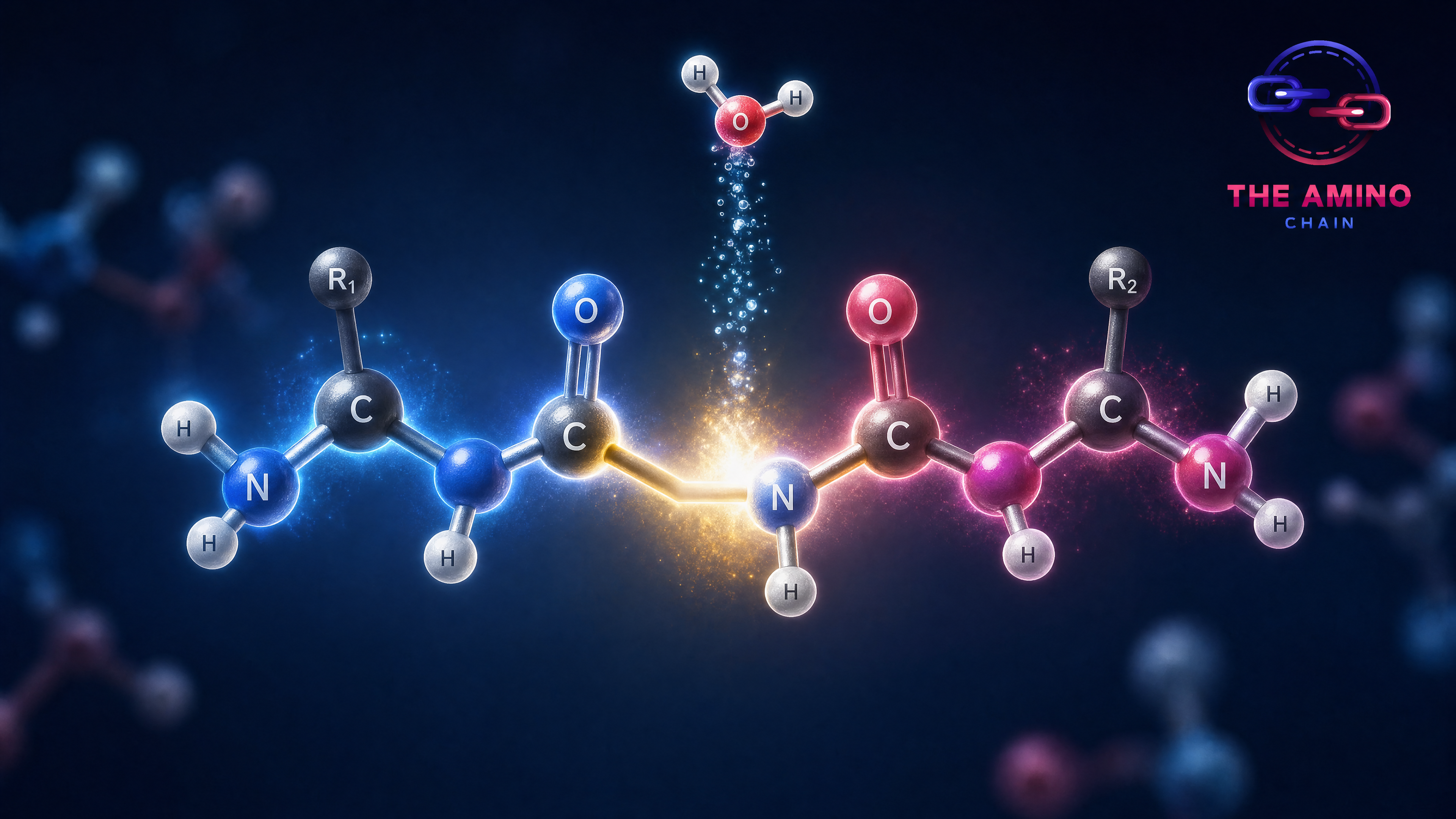
A peptide bond forms through a condensation reaction (also called a dehydration synthesis) between the carboxyl group (-COOH) of one amino acid and the amino group (-NH2) of another. During the reaction, a water molecule (H2O) is released, and the two amino acids become linked by a covalent bond between the carbon of the carboxyl group and the nitrogen of the amino group: -CO-NH-. This -CO-NH- linkage is the peptide bond.
The reaction is thermodynamically unfavorable under physiological conditions — it requires energy input. In biological systems, ribosomes use GTP energy to drive peptide bond formation during protein translation. In chemical synthesis (SPPS), coupling reagents provide the activation energy by converting the carboxyl group into a more reactive intermediate that readily reacts with the amine.
Peptide Bond Geometry: Planar and Rigid
The peptide bond is not a simple single bond — it has partial double bond character due to resonance. The nitrogen's lone pair of electrons delocalizes into the carbonyl, creating a resonance structure where the C-N bond has approximately 40% double bond character. This partial double bond has two critical consequences.
First, the peptide bond is planar — the six atoms surrounding it (C-alpha, C, O, N, H, C-alpha) all lie in the same plane. This planarity constrains the backbone geometry of the peptide chain, limiting the conformations available to the molecule and influencing its three-dimensional structure.
Second, the partial double bond character means the peptide bond cannot rotate freely. Rotation is restricted to the flanking bonds (phi and psi angles at the C-alpha carbons), not at the peptide bond itself. This rotational restriction is a major determinant of peptide and protein folding.
Trans vs Cis Configuration
The planar peptide bond can exist in two configurations: trans (the two C-alpha carbons on opposite sides of the C-N bond) and cis (on the same side). The trans configuration is strongly favored (approximately 99.9% of peptide bonds in proteins are trans) because the cis configuration creates steric clash between the side chains of adjacent amino acids.
The exception is proline, whose cyclic side chain reduces the energy difference between cis and trans configurations. Approximately 5-6% of X-Pro peptide bonds adopt the cis configuration. This is relevant for proline-rich peptides like BPC-157 (which contains four prolines) — the cis-trans isomerism at proline residues can affect the peptide's structural flexibility and biological properties.
Bond Strength and Stability
The peptide bond is a strong covalent bond with a bond dissociation energy of approximately 340 kJ/mol. Under physiological conditions (neutral pH, 37 degrees C), the half-life for spontaneous (non-enzymatic) hydrolysis of a peptide bond is estimated at 350-600 years. Peptide bonds are remarkably stable under normal conditions — they don't spontaneously break apart.
So why do peptides degrade so quickly in biological systems? The answer is enzymatic catalysis. Proteolytic enzymes (proteases) accelerate peptide bond hydrolysis by factors of 10^10 to 10^12, reducing the half-life from centuries to milliseconds. This enzymatic vulnerability — not inherent bond instability — is why peptides require careful storage and have short in vivo half-lives.
Hydrolysis: Breaking Peptide Bonds
Peptide bond hydrolysis is the reverse of condensation — water is added across the bond, breaking the C-N linkage and regenerating the free carboxyl and amino groups. Hydrolysis can be catalyzed by acid (gastric HCl, used in amino acid analysis), base (NaOH, used in laboratory analysis), or enzymes (proteases, the biological mechanism).
Different proteases cleave peptide bonds at different positions. Exopeptidases (aminopeptidases, carboxypeptidases) trim amino acids from the ends. Endopeptidases (trypsin, chymotrypsin, pepsin) cleave internal bonds with sequence specificity. This is why terminal modifications (N-acetylation, C-amidation) can dramatically extend peptide half-life — they block exopeptidase access without affecting internal bonds.
Why This Matters for Researchers
Understanding peptide bond chemistry informs practical research decisions. Storage conditions affect hydrolysis rate (lower temperature = slower degradation). pH affects stability (extreme pH accelerates hydrolysis). Sequence composition affects protease susceptibility (proline-adjacent bonds are resistant to many proteases, explaining BPC-157's stability). And terminal modifications affect half-life (the N-Ac and C-amide modifications used in compounds like N-Acetyl Selank Amidate specifically protect against exopeptidase degradation).