Peptide vs Protein: What's the Difference and Why Does It Matter for Research?
Peptides and proteins are both amino acid chains, but the distinction matters for stability, delivery, manufacturing, and biological activity. This guide explains the real differences and why they matter for peptide researchers.
Every peptide is a chain of amino acids. Every protein is a chain of amino acids. So what's the difference? The answer isn't as clean as textbooks suggest — there's no sharp dividing line — but the distinction has real practical implications for research. Peptides and proteins differ in size, structure, stability, manufacturing complexity, delivery challenges, and biological behavior in ways that directly affect how researchers work with them.
The Size Distinction
The conventional dividing line places peptides at roughly 2-50 amino acids and proteins at 50+ amino acids. But this cutoff is arbitrary — there's nothing magical about the 50th amino acid that transforms a peptide into a protein. Insulin at 51 amino acids is commonly called both a peptide hormone and a protein. GLP-1 at 30 amino acids is unambiguously a peptide. Growth hormone at 191 amino acids is unambiguously a protein.
In practice, most research peptides fall well within the peptide range: BPC-157 (15 amino acids), TB-500 (43 amino acids), GHK-Cu (3 amino acids), Selank (7 amino acids), Semax (7 amino acids), and the incretin peptides (30-39 amino acids).
Why Size Matters: Structure
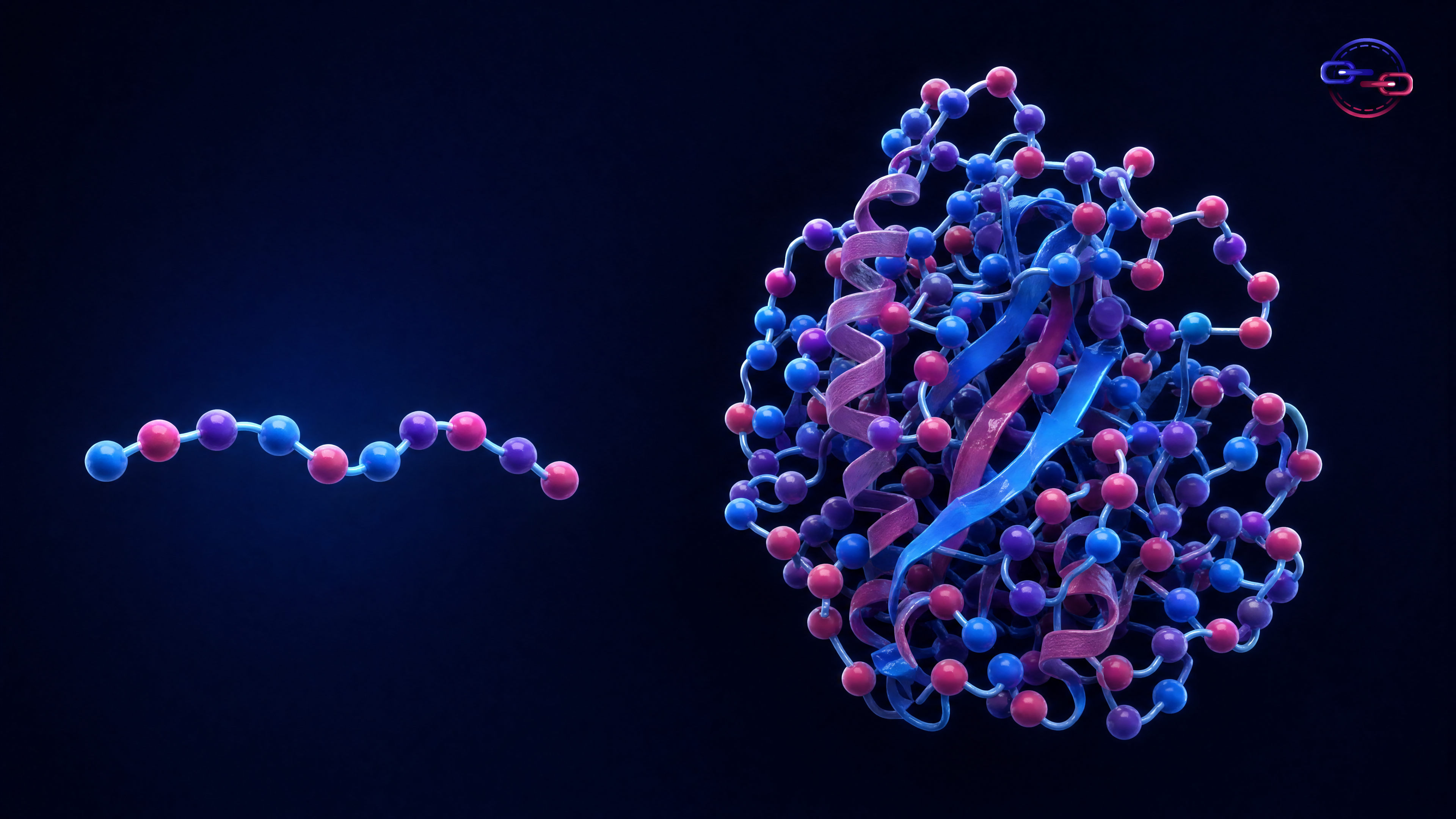
The most important functional difference between peptides and proteins is structural complexity. Small peptides (under approximately 20 amino acids) are generally flexible molecules without a stable three-dimensional structure in solution — they exist as ensembles of rapidly interconverting conformations. Proteins have defined three-dimensional structures (secondary, tertiary, and sometimes quaternary structure) stabilized by hydrogen bonds, hydrophobic interactions, and disulfide bonds.
This structural difference has practical implications. Protein function depends on maintaining precise three-dimensional structure — denaturation (unfolding) destroys activity. Small peptide function depends primarily on the amino acid sequence itself rather than a specific fold, making peptides generally more robust to conditions that would denature proteins.
Why Size Matters: Stability
Peptides and proteins degrade through different pathways. Small peptides are primarily degraded by exopeptidases (enzymes that clip amino acids from the ends) and endopeptidases (enzymes that cut internal peptide bonds). Proteins are additionally vulnerable to denaturation — loss of three-dimensional structure through heat, pH changes, or agitation that doesn't break covalent bonds but destroys the functional fold.
Practically, lyophilized peptides are generally more storage-stable than proteins. A lyophilized peptide stored at -20C can maintain potency for years. Proteins may require more stringent storage conditions, cryoprotectants, and careful handling to maintain their native fold.
Why Size Matters: Manufacturing
Peptides under approximately 50 amino acids can be efficiently produced by chemical synthesis — solid-phase peptide synthesis (SPPS) can build chains of this length with acceptable yield and purity. Proteins longer than 50 amino acids become increasingly difficult and expensive to synthesize chemically, and are typically produced by recombinant DNA technology — engineering bacteria or cell cultures to produce the protein biologically.
This manufacturing distinction affects cost, purity, and availability. Chemically synthesized peptides can achieve very high purity (99%+) through HPLC purification. Recombinant proteins may contain host cell protein contaminants, endotoxins, and other biological impurities that require additional purification steps.
Why Size Matters: Delivery
Both peptides and proteins are generally poorly absorbed orally — gastric acid and digestive enzymes destroy them. Both typically require injection for systemic delivery. However, small peptides have advantages for alternative delivery routes: some peptides (like Selank and Semax at 7 amino acids) can be administered intranasally with meaningful absorption. BPC-157's oral bioactivity is exceptional even among small peptides. Larger proteins are essentially limited to injection.
The Bottom Line for Researchers
For practical purposes, the peptide-protein distinction tells you what to expect about stability (peptides are more robust), manufacturing (peptides are chemically synthesized), cost (shorter peptides are generally cheaper), delivery options (peptides have more route flexibility), and storage requirements (peptides are generally less finicky). Understanding these differences helps researchers design better protocols, evaluate supplier quality, and interpret biological results in the appropriate context.