The Complete Guide to Peptides for Joint Health: Cartilage, Synovial Fluid, Inflammation, and Repair
Joint health involves cartilage, synovial fluid, subchondral bone, tendons, and ligaments. Published research on BPC-157, TB-500, AOD-9604, GHK-Cu, and pentosan polysulfate reveals how different peptides target different components of joint biology.
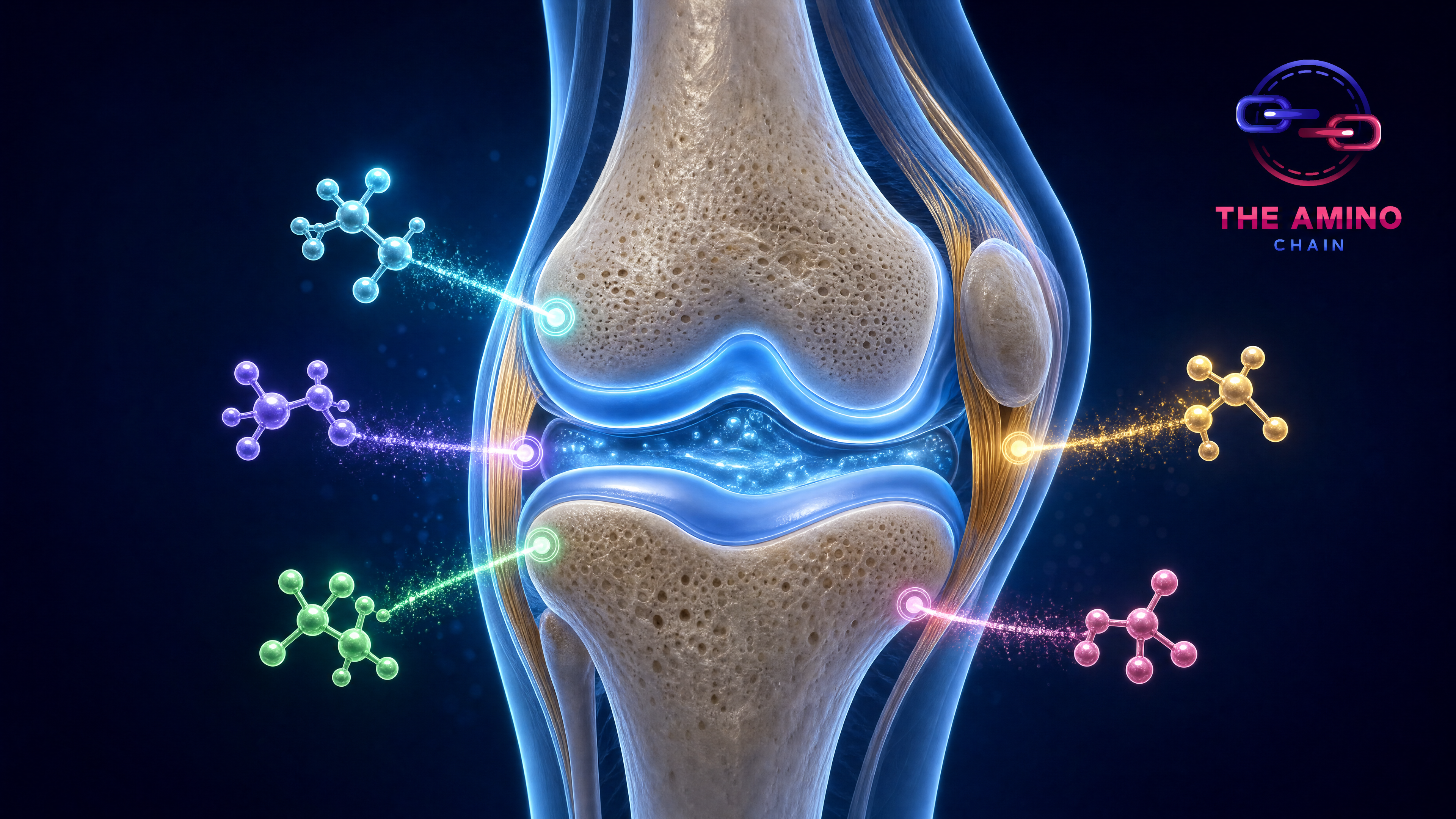
Joints are not simple hinges — they are complex biological systems involving multiple tissue types working in concert. Articular cartilage provides the smooth bearing surface. Synovial fluid provides lubrication and nutrient delivery. Subchondral bone supports the cartilage from beneath. Tendons and ligaments provide stability and force transmission. The synovial membrane maintains the joint capsule environment. When any component fails, the entire system deteriorates — which is why effective joint health approaches must address multiple tissue targets rather than focusing on a single structure.
Why Joints Are Vulnerable
Articular cartilage is uniquely vulnerable for several reasons. It has no blood supply — receiving nutrients solely through diffusion from synovial fluid. It has no nerve supply — so damage progresses silently until it reaches the underlying bone. Its resident cells (chondrocytes) have limited proliferative capacity — they can't rapidly multiply to repair damage the way skin or liver cells can. And it exists under constant mechanical loading — every step, squat, or stair climb compresses the cartilage surface.
This combination of poor nutrient supply, limited regenerative capacity, and constant mechanical stress makes articular cartilage one of the most difficult tissues to maintain and repair. Once significant cartilage loss occurs, the body has very limited ability to regenerate it.
BPC-157: The Multi-Target Joint Peptide
BPC-157's published joint research spans multiple tissue targets. For cartilage, BPC-157 protected chondrocytes against inflammatory damage and promoted repair in cartilage defect models. For tendons, BPC-157 accelerated healing of Achilles, patellar, and rotator cuff tendons with improved mechanical properties. For ligaments, published data showed faster healing and greater tensile strength in medial collateral ligament injury models.
The multi-target profile reflects BPC-157's broad mechanisms: VEGF-mediated angiogenesis improves nutrient delivery to hypovascular joint structures. Growth factor receptor upregulation enhances the tissue's response to repair signals. Anti-inflammatory effects reduce the inflammatory environment that drives cartilage degradation. And the NO modulatory effects influence vascular tone and inflammatory signaling in the synovial membrane.
TB-500: Cell Migration and Inflammation
TB-500's relevance to joint health centers on two mechanisms: promoting repair cell migration to injury sites and modulating the inflammatory environment within the joint capsule. Synovial joints are enclosed spaces where inflammatory mediators accumulate — creating a self-perpetuating cycle of inflammation, cartilage degradation, and further inflammation. TB-500's anti-inflammatory effects (TNF-alpha, IL-1beta, IL-6 reduction) may help break this cycle.
TB-500's actin-sequestering mechanism supports the migration of mesenchymal stem cells and fibroblasts to damaged joint structures — cells that are needed for ligament and tendon repair but must traverse the joint space to reach injury sites.
AOD-9604: Cartilage-Specific Effects
AOD-9604's cartilage effects distinguish it from tissue-healing peptides like BPC-157 and TB-500. Published research showed AOD-9604 directly stimulated chondrocyte proteoglycan and collagen synthesis — the matrix components that give cartilage its compressive strength and resilience. This chondroprotective effect addresses cartilage maintenance rather than injury repair, potentially slowing the progressive cartilage loss that characterizes osteoarthritis.
GHK-Cu: Matrix and Collagen Support
GHK-Cu's collagen synthesis, lysyl oxidase activation, and glycosaminoglycan production are relevant to the extracellular matrix components of joint tissues. Cartilage ECM (type II collagen, aggrecan, hyaluronic acid), tendon ECM (type I collagen, decorin), and synovial fluid (hyaluronic acid) all depend on active matrix synthesis and maintenance. GHK-Cu's MMP inhibition may also protect existing joint matrix from degradation.
Pentosan Polysulfate: Synovial and Subchondral
PPS addresses joint compartments that most peptides don't directly target. Its stimulation of hyaluronic acid production by synoviocytes improves synovial fluid viscosity — the lubricant that reduces friction between cartilage surfaces. Its effects on subchondral bone blood flow address the vascular component of joint health that lies beneath the cartilage surface. And its MMP inhibition provides a broad anti-degradation effect across joint tissues.
Building a Joint Protocol: Matching Peptides to Problems
Different joint problems suggest different peptide approaches. Acute tendon or ligament injury: BPC-157 + TB-500 for tissue repair and inflammation. Progressive cartilage loss (osteoarthritis): AOD-9604 + PPS for cartilage protection and synovial support. Post-surgical joint recovery: BPC-157 for healing + PPS for adhesion prevention. General joint maintenance: GHK-Cu for matrix support + PPS for synovial health.
These are rational combinations based on published mechanisms, not proven clinical protocols. The research supporting specific multi-peptide joint protocols in controlled human studies is essentially nonexistent — the rationale is mechanistic, not evidence-based at the protocol level.
What Peptides Can't Replace
Regardless of peptide research, joint health fundamentally depends on appropriate mechanical loading (exercise that strengthens supporting muscles without overloading joint surfaces), maintaining healthy body weight (every pound of body weight equals 4 pounds of force on the knee with each step), adequate nutrition (vitamin C for collagen synthesis, vitamin D for bone health, omega-3 fatty acids for inflammation), and medical evaluation for significant joint problems (structural damage may require surgical intervention that peptides cannot substitute for).