Peptides and Proteins: Understanding the Key Differences in Structure, Function, and Why Biology Treats Them Differently
Peptides and proteins are both amino acid chains but biology handles them very differently. This guide explains the structural, functional, and pharmacological differences that matter for research — going deeper than the simple size distinction.
The textbook answer — "peptides are short amino acid chains, proteins are long ones" — is technically correct but misses the biology that makes the distinction meaningful. Peptides and proteins differ not just in size but in how they fold, how the body processes them, how they signal, how they're manufactured, and how they behave as research tools. Understanding these differences at the biological level explains why peptide research works the way it does.
The Size Question: It's Not Just Length
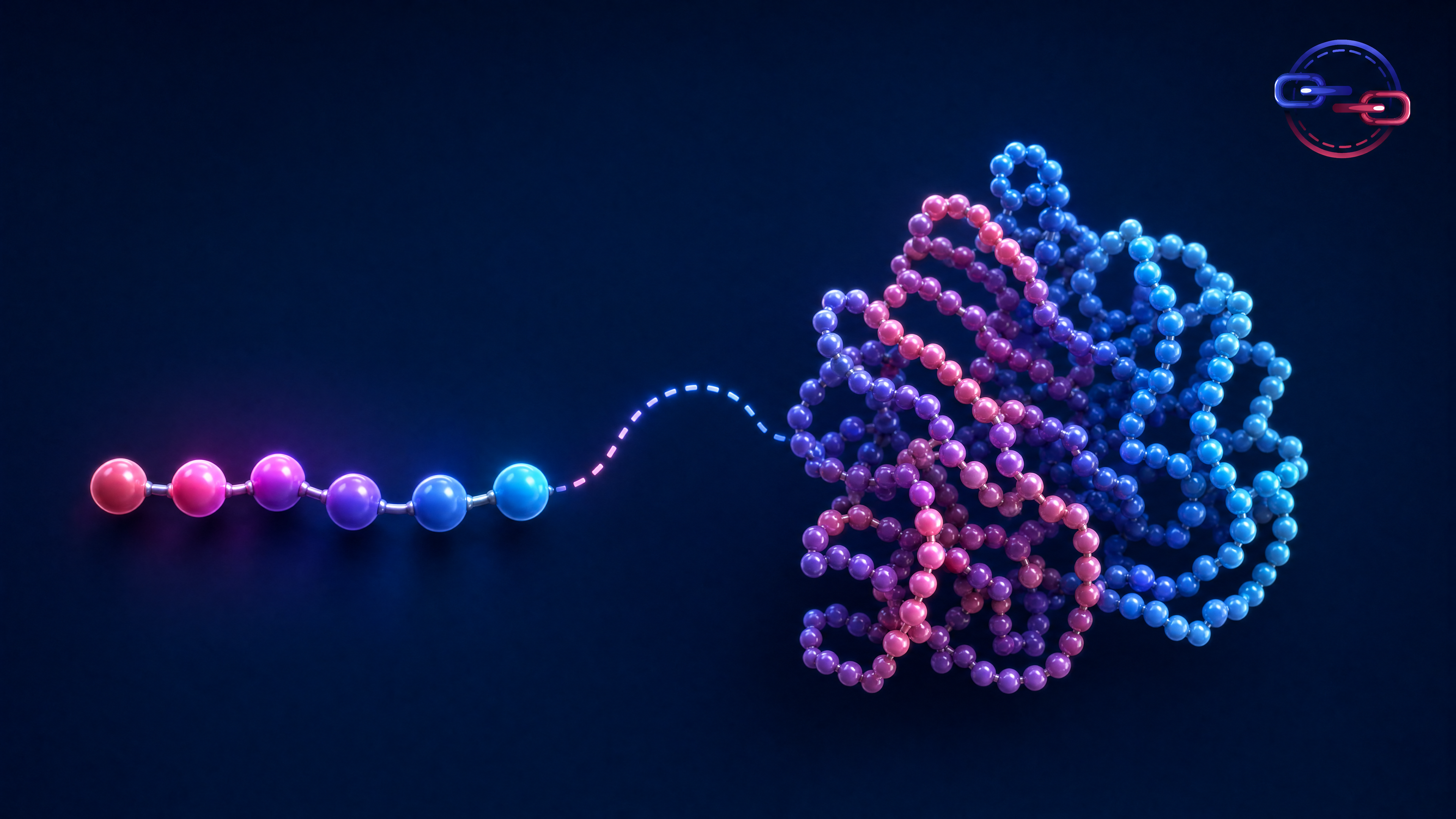
Convention places the dividing line around 50 amino acids — below that is a peptide, above is a protein. But the biologically meaningful distinction isn't length itself; it's what happens structurally at different chain lengths. Short chains (under approximately 20 amino acids) are generally too small to fold into stable three-dimensional structures — they exist as flexible, disordered chains that adopt different shapes moment to moment. Longer chains (above approximately 40-50 amino acids) can fold into stable structures with defined secondary structure (alpha helices, beta sheets) and tertiary structure (the overall three-dimensional fold).
This structural distinction matters enormously. Protein function depends on maintaining a precise three-dimensional shape — the shape determines which receptors it binds, which enzymes it catalyzes, which structures it forms. Disrupting the shape (denaturation) destroys function, even though every covalent bond remains intact. Most peptides don't have a defined shape to lose — their function depends on their amino acid sequence rather than a specific fold.
How Biology Processes Them Differently
The body handles peptides and proteins through different metabolic pathways. Small peptides are degraded primarily by exopeptidases (trimming amino acids from the ends) and small endopeptidases. This degradation is fast — most peptides have half-lives measured in minutes. Proteins are degraded through more complex pathways: the ubiquitin-proteasome system for intracellular proteins, receptor-mediated endocytosis and lysosomal degradation for extracellular proteins, and proteolytic cascades for blood-borne proteins.
This processing difference explains why peptides generally have shorter durations of action than proteins. Insulin (51 amino acids, borderline peptide/protein) has a half-life of 5-6 minutes. Growth hormone (191 amino acids, clearly a protein) has a half-life of 15-20 minutes. Albumin (585 amino acids, large protein) has a half-life of 19 days. Size and structural stability both contribute to how quickly the body clears them.
Signaling Differences
Peptide hormones and protein hormones both signal through cell-surface receptors, but with different characteristics. Small peptides often have high receptor affinity but low selectivity — their small size means they interact with a limited surface area of the receptor, and small structural changes can shift receptor preference. Proteins interact with larger receptor surfaces, potentially achieving greater selectivity through more extensive binding interfaces.
This is why peptide analogs are relatively easy to design — changing one or two amino acids in a 7-amino acid peptide can create a compound with different receptor selectivity. Protein engineering is more complex because changes must preserve the overall fold while modifying the specific binding surface.
Manufacturing Differences
The manufacturing divide is practical and economic. Peptides under approximately 50 amino acids are efficiently produced by solid-phase chemical synthesis (SPPS) — an automated chemical process that builds the chain one amino acid at a time. Cost scales roughly linearly with length for small peptides. Proteins above 50 amino acids are typically produced by recombinant DNA technology — inserting the gene into bacteria, yeast, or mammalian cells and harvesting the expressed protein.
Chemical synthesis provides high purity (99%+) and complete sequence control, including the ability to incorporate non-natural amino acids and chemical modifications. Recombinant production may introduce host-cell protein contaminants, requires more extensive purification, and is limited to the 20 natural amino acids (without specialized engineering). This is why research peptides are chemically synthesized while therapeutic proteins (antibodies, enzymes) are produced recombinantly.
Stability and Storage
Peptides are generally more robust than proteins for storage and handling. Without a defined tertiary structure to maintain, peptides are not susceptible to denaturation — they can tolerate temperature fluctuations, pH changes, and mechanical stress that would irreversibly unfold a protein. Lyophilized peptides stored at -20C can maintain potency for years. Proteins may require cryoprotectants, controlled freezing rates, and more careful handling to preserve their native fold.
Immunogenicity
Proteins are more likely to trigger immune responses (immunogenicity) than small peptides. The immune system recognizes foreign proteins through their surface features — larger proteins present more potential epitopes (binding sites for antibodies). Small peptides may be too small to trigger robust immune responses, though larger peptides (30+ amino acids) can be immunogenic, particularly with repeated administration. This is why anti-drug antibodies are a concern for therapeutic proteins (antibodies, recombinant hormones) but rarely reported for small research peptides.
The Practical Bottom Line
For researchers, the peptide-protein distinction translates to practical differences in handling, storage, cost, delivery, and expected pharmacokinetics. Peptides are cheaper to synthesize, more stable to store, faster-acting but shorter-lasting, and more flexible for chemical modification. Proteins are more expensive, require more careful handling, have longer durations of action, and are harder to modify. Understanding these differences helps researchers choose appropriate compounds and design rational protocols.