Understanding Peptide Bonds: The Chemistry That Holds It All Together
The peptide bond is the most fundamental concept in peptide science, yet few researchers understand what makes it unique. This article explores the chemistry, stability, and vulnerability of the bond that defines every research compound you work with.
Every peptide you've ever worked with — BPC-157, TB-500, GHK-Cu, every GLP-1 analog — is held together by the same fundamental chemical linkage: the peptide bond. Understanding this bond isn't just academic trivia. It explains why peptides degrade the way they do, why storage conditions matter, why certain modifications improve stability, and why your reconstitution technique affects biological activity.
What Is a Peptide Bond?
A peptide bond is a covalent amide linkage formed between the carboxyl group (-COOH) of one amino acid and the amino group (-NH2) of another, with the release of one molecule of water. This condensation reaction creates a C-N bond that is the backbone of every peptide and protein in biology.
The reaction is thermodynamically unfavorable under standard conditions — meaning peptide bonds don't form spontaneously in solution. In biological systems, the cell's ribosomal machinery uses ATP energy to drive bond formation. In the laboratory, synthetic chemistry uses coupling reagents to activate the carboxyl group and make the reaction proceed efficiently.
The Partial Double Bond Character
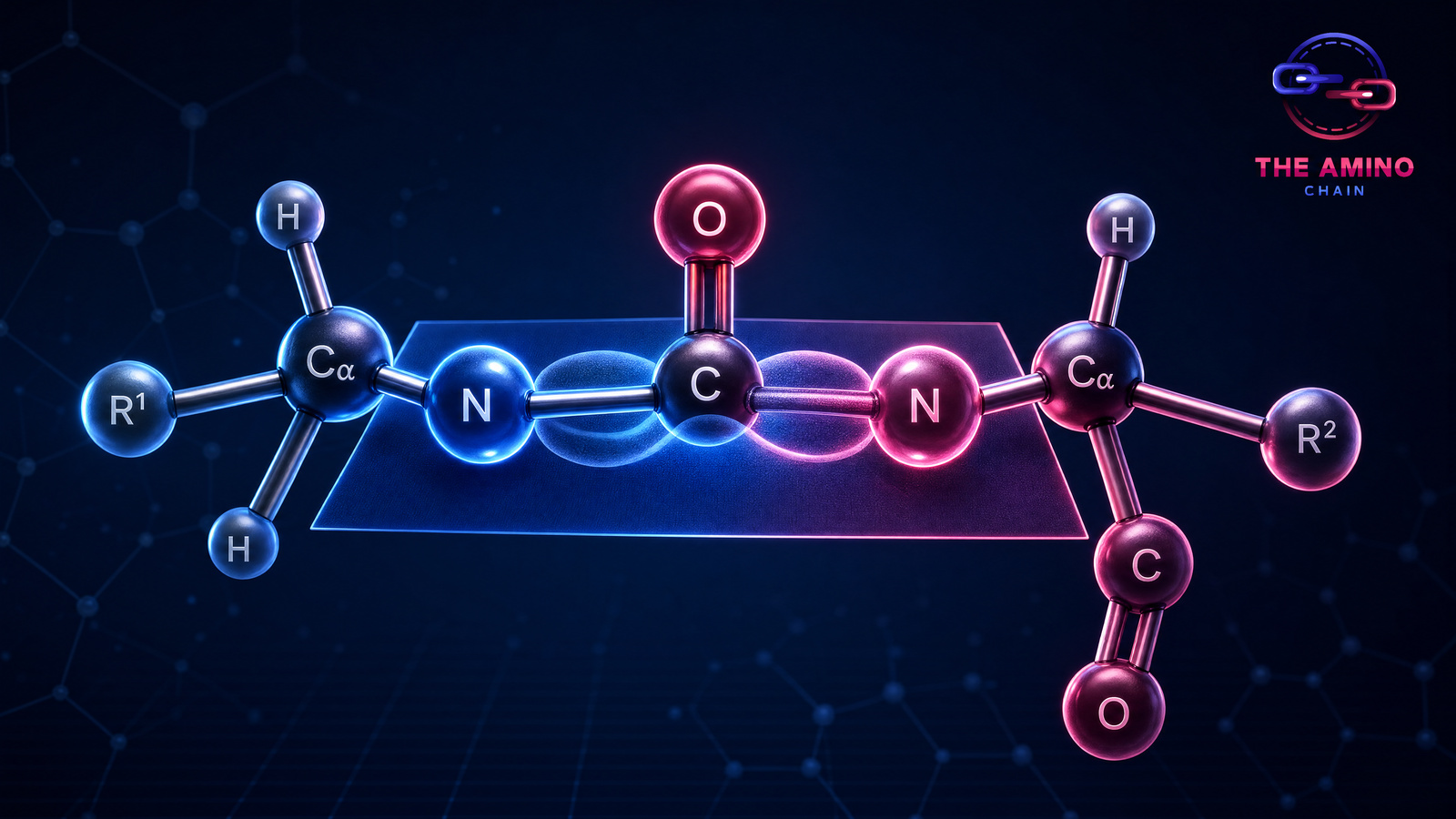
What makes the peptide bond special among amide bonds is its partial double bond character. The lone pair electrons on the nitrogen atom are delocalized into the carbonyl group, creating a resonance structure where the C-N bond has approximately 40% double bond character.
This has two critical consequences. First, the bond is planar — the six atoms involved (C-alpha, C, O, N, H, C-alpha) all lie in the same plane. This planarity is fundamental to peptide structure because it restricts the backbone to rotating only around two bonds per amino acid (phi and psi angles), which is what allows peptides to fold into defined three-dimensional structures.
Second, the partial double bond character makes the peptide bond more stable than a typical single C-N bond. The bond dissociation energy is approximately 330 kJ/mol — strong enough to maintain structural integrity under physiological conditions but vulnerable to specific chemical and enzymatic attack.
Trans vs Cis Configuration
Because of the partial double bond character, the peptide bond exists in either trans or cis configuration — and overwhelmingly prefers trans. In the trans configuration, the two C-alpha atoms on either side of the bond are on opposite sides, minimizing steric clash. Over 99.5% of peptide bonds in known protein structures are trans.
The major exception involves proline residues, where the cis configuration is observed in approximately 5-6% of cases. This is because proline's cyclic side chain reduces the energetic penalty for cis adoption. Cis-proline bonds play important roles in protein folding and can affect the biological activity of proline-containing research peptides.
How Peptide Bonds Break: Hydrolysis
The primary degradation pathway for peptide bonds is hydrolysis — the reverse of the condensation reaction that formed them. Water attacks the carbonyl carbon, breaking the C-N bond and regenerating the free amino and carboxyl groups. This is the fundamental reason why reconstituted peptides have limited shelf life: the water you add to dissolve them is also the reagent that eventually destroys them.
Hydrolysis rates depend on several factors. Temperature accelerates hydrolysis following Arrhenius kinetics — roughly doubling for every 10 degree increase. pH affects hydrolysis rates, with both very acidic and very basic conditions accelerating bond cleavage. Specific amino acid sequences are more vulnerable — bonds adjacent to aspartic acid residues are particularly susceptible to acid-catalyzed cleavage.
Enzymatic Cleavage: Proteases
In biological systems, peptide bonds are cleaved by proteases — enzymes specifically evolved to hydrolyze amide linkages. Different proteases recognize different amino acid sequences, which is why peptides have characteristic half-lives in biological fluids. DPP-4, for example, cleaves after the second amino acid position if it's proline or alanine — which is why native GLP-1 has a half-life of only 2 minutes in plasma.
Understanding protease susceptibility is central to peptide drug design. Modifications that protect vulnerable cleavage sites — D-amino acid substitution, backbone methylation, cyclization — extend the functional lifetime of research peptides and therapeutic analogs.
Deamidation: The Silent Degradation
Asparagine and glutamine residues are vulnerable to a degradation pathway called deamidation, where the side chain amide group is converted to a carboxylic acid (forming aspartic acid or glutamic acid, respectively). This reaction doesn't break the peptide backbone but changes the charge and structure of the affected residue, potentially altering biological activity.
Deamidation is accelerated by elevated pH, elevated temperature, and the presence of water — making it a significant concern for reconstituted peptide storage. It's detectable by mass spectrometry (adding 1 Da per deamidation event) but can be missed by HPLC if the modified peptide has similar retention time to the parent compound.
Oxidation: The Other Major Threat
Methionine, cysteine, histidine, tryptophan, and tyrosine residues are all susceptible to oxidation by dissolved oxygen, reactive oxygen species, or light exposure. Methionine oxidation (adding 16 Da, detectable by mass spec) is the most common and often the first degradation product observed during peptide storage.
This is why storage recommendations emphasize minimizing air exposure, protecting from light, and using inert headspace gas in vials when possible. It's also why HPLC purity can decrease over time even under refrigerated conditions — the peptide isn't hydrolyzing but is slowly oxidizing.
Why This Chemistry Matters for Your Research
Understanding peptide bond chemistry transforms storage and handling from a set of arbitrary rules into logical practices. You refrigerate because temperature accelerates hydrolysis. You minimize air exposure because oxygen drives oxidation. You avoid extreme pH because it catalyzes bond cleavage. You protect from light because photons initiate radical oxidation.
Every best practice in peptide research traces back to protecting or working with the fundamental chemistry of the peptide bond. Understanding that chemistry makes you a better researcher, not just a better rule follower.