BPC-157 and Bone Fractures: Research on Fracture Healing and Bone Biology
Bone fracture healing shares key pathways with soft tissue repair — angiogenesis, cell migration, and growth factor signaling. Published BPC-157 research on bone biology examines how this peptide may influence fracture recovery.
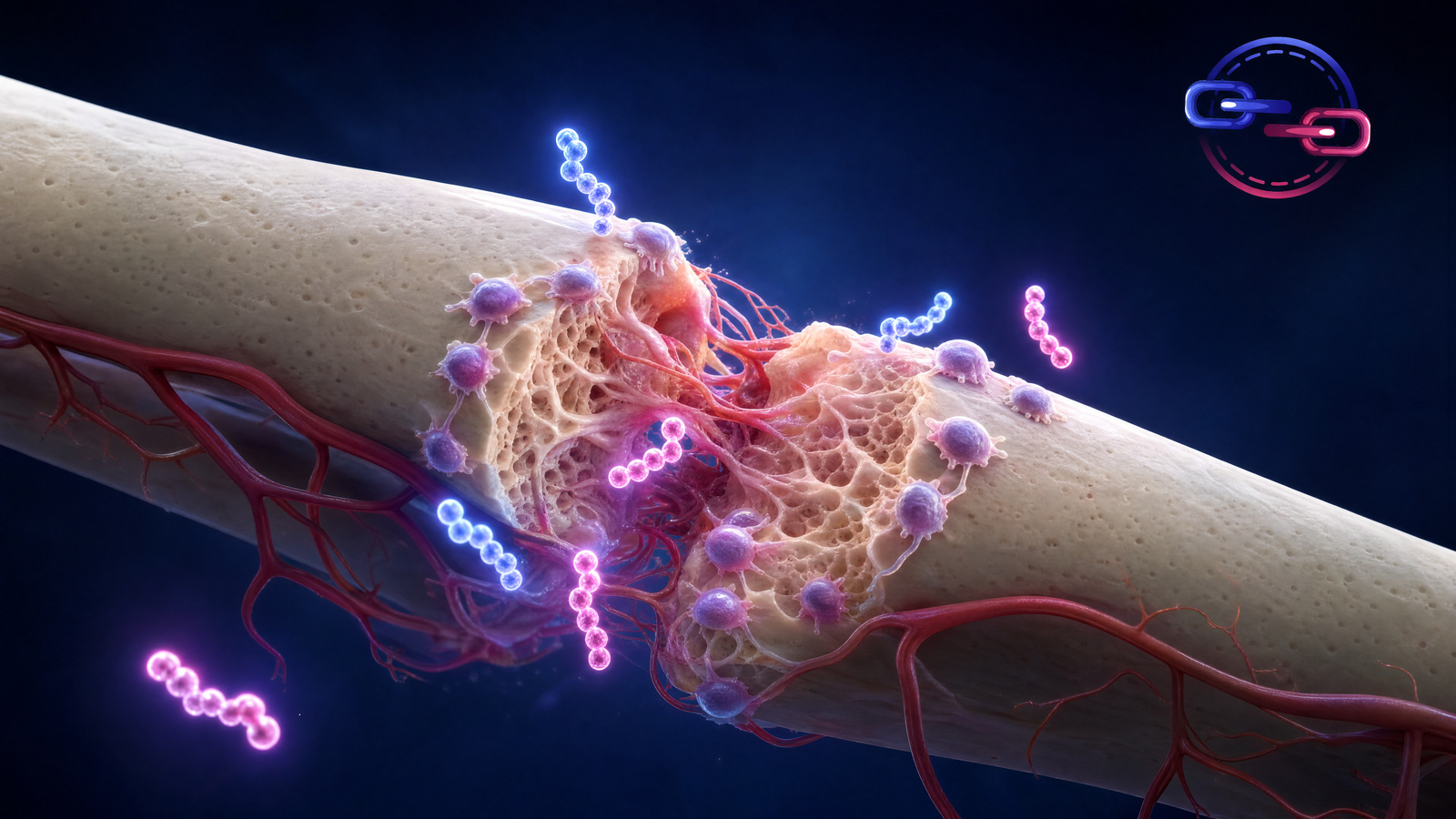
Bone seems fundamentally different from the soft tissues where BPC-157 has been most extensively studied. But fracture healing is a biological process that shares critical pathways with soft tissue repair: inflammation, angiogenesis, cell recruitment, and tissue remodeling. Published research on BPC-157's effects on bone biology reveals connections between its established mechanisms and the specific requirements of fracture healing.
How Bones Heal
Fracture healing is a remarkable biological process that, unlike scar-forming soft tissue repair, produces tissue identical to the original — true regeneration rather than repair. The process proceeds through four overlapping phases: inflammation (0-7 days), soft callus formation (7-21 days), hard callus formation (21-60 days), and remodeling (60 days to years).
During the soft callus phase, mesenchymal stem cells differentiate into chondrocytes that produce a cartilaginous bridge across the fracture gap. This cartilaginous callus is then gradually replaced by woven bone through endochondral ossification — the same process by which most bones form during embryonic development. Finally, woven bone is remodeled into organized lamellar bone through osteoclast (bone-removing) and osteoblast (bone-forming) activity.
Angiogenesis: Critical for Bone Healing
Blood supply is as critical for bone healing as it is for any tissue repair process. The fracture disrupts local blood vessels, creating an avascular zone at the fracture site. New blood vessel formation (angiogenesis) must occur to deliver oxygen, nutrients, and progenitor cells to the healing fracture. Inadequate angiogenesis is a primary cause of non-union — fractures that fail to heal.
BPC-157's well-documented promotion of VEGF-mediated angiogenesis is directly relevant to this bottleneck. Published studies showing enhanced neovascularization in BPC-157-treated healing tissue suggest the peptide could support the critical revascularization phase of fracture healing.
Published BPC-157 Bone Research
Published studies have examined BPC-157's effects on bone healing in rodent fracture models. The peptide demonstrated accelerated bone formation at the fracture site, with increased callus formation and improved biomechanical strength of healing fractures at matched timepoints compared to controls.
Radiographic and histological analysis showed earlier mineralization of the callus, more advanced remodeling from woven to lamellar bone, and improved structural organization of the healing bone tissue. These findings suggest BPC-157 may accelerate multiple phases of the fracture healing cascade simultaneously.
Growth Factor Signaling in Bone
Bone healing depends on multiple growth factors including BMP (bone morphogenetic proteins), VEGF, FGF (fibroblast growth factor), PDGF (platelet-derived growth factor), and TGF-beta. BPC-157's demonstrated upregulation of growth factor receptors — particularly EGF and VEGF receptors — may amplify the signaling environment that drives fracture healing, enhancing osteoprogenitor cell recruitment and differentiation.
The Periosteum Connection
The periosteum — the fibrous membrane covering bone surfaces — is the primary source of progenitor cells for fracture healing. Periosteal cells proliferate rapidly after fracture and differentiate into both chondrocytes (for soft callus) and osteoblasts (for hard callus). BPC-157's promotion of cell migration through the FAK-paxillin pathway and its growth factor effects may enhance periosteal cell activation and mobilization.
Osteoporotic Fracture Healing
Osteoporotic bone heals more slowly and with lower quality callus than healthy bone. The cellular response to fracture — stem cell recruitment, osteoblast differentiation, angiogenesis — is impaired in osteoporotic individuals. Published research suggests that BPC-157's biological effects address several of these impairments, though specific studies in osteoporotic fracture models are limited.
Tendon-Bone Interface
Many clinically important injuries involve the tendon-bone junction (enthesis) — where tendons insert into bone. Rotator cuff repairs, ACL reconstructions, and Achilles tendon reattachments all require healing at this interface. BPC-157's demonstrated effects on both tendon healing and bone biology make it theoretically relevant to enthesis healing, where both tissue types must regenerate and integrate simultaneously.
Research Context
Bone healing research with BPC-157 is less extensive than the peptide's tendon or GI research, but the mechanistic connections are strong. Fracture healing depends on the same biological processes — angiogenesis, cell recruitment, growth factor signaling, inflammation modulation — that BPC-157 consistently influences in other tissue systems. Evidence-based fracture management (appropriate immobilization, surgical fixation when indicated, calcium and vitamin D optimization, and progressive loading) remains the standard of care.