BPC-157 Oral vs Injectable: What Published Research Says About Each Administration Route
BPC-157 is one of the few peptides with documented oral bioactivity. Published research compares oral versus injectable administration for different applications, revealing that route of delivery matters more than most researchers realize.
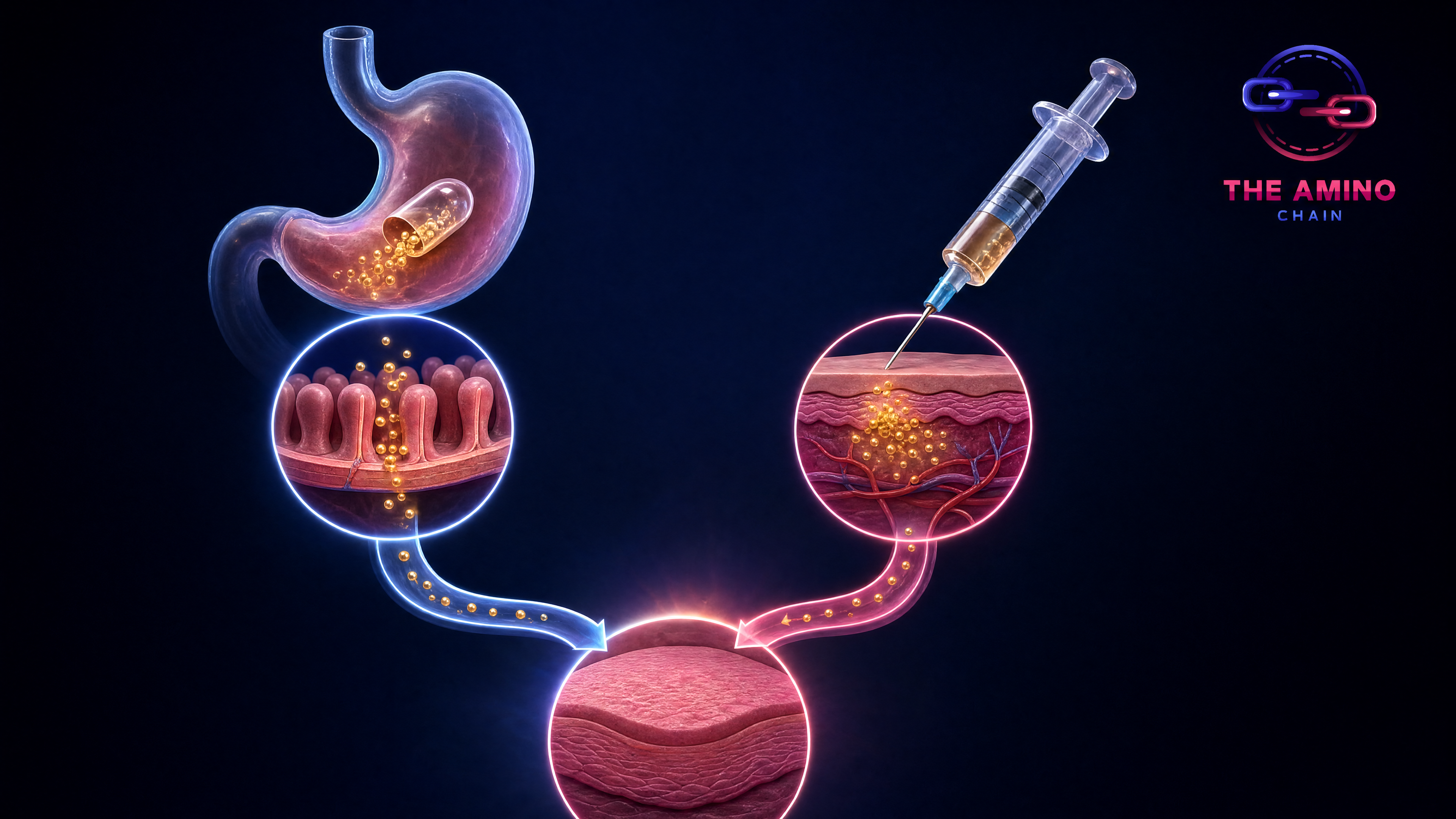
Most peptides are destroyed in the stomach within minutes. BPC-157 is a striking exception — it was originally isolated from gastric juice, where it survives the brutally acidic environment (pH 1-2) that denatures virtually every other peptide. This gastric stability gives researchers a choice that doesn't exist with most peptides: oral or injectable administration. Published research has examined both routes, and the findings reveal important differences in absorption, distribution, and therapeutic outcomes depending on the target tissue.
Why Most Peptides Can't Be Taken Orally
The gastrointestinal tract is designed to break down proteins and peptides into individual amino acids for absorption. Pepsin in the stomach, trypsin and chymotrypsin in the small intestine, and brush border peptidases all work to disassemble peptide bonds. Additionally, gastric acid denatures protein structure, and the intestinal epithelium has limited permeability to intact peptides larger than 2-3 amino acids. For most research peptides — TB-500 (43 amino acids), thymosin alpha-1 (28 amino acids), or GH secretagogues — oral administration is not viable.
BPC-157's Gastric Stability
BPC-157's resistance to gastric degradation stems from its unusual amino acid composition. Four of its 15 amino acids are proline — a cyclic amino acid whose ring structure creates backbone rigidity that resists protease cleavage. The proline-rich sequence creates structural constraints that make the peptide bonds flanking proline residues resistant to the conformational changes needed for enzymatic hydrolysis.
Published stability studies confirmed BPC-157 maintains structural integrity in gastric juice for extended periods — far longer than any other bioactive peptide tested under the same conditions. This stability is not absolute (some degradation occurs over hours), but it provides a sufficient window for absorption of intact, active peptide.
Oral Administration: Published Evidence
Published research using oral BPC-157 has demonstrated biological effects across multiple organ systems. Oral administration showed gastroprotective effects (protecting against NSAID-induced ulcers, alcohol-induced gastric damage, and stress ulcers), hepatoprotective effects (protecting against liver damage from various toxins), and intestinal healing effects (improving inflammatory bowel disease models and protecting intestinal barrier function).
The GI-specific effects of oral BPC-157 make intuitive sense — the peptide has direct contact with the tissue it's protecting. However, published research also demonstrated systemic effects from oral administration: wound healing acceleration, tendon repair enhancement, and even CNS effects including dopaminergic modulation. These systemic effects require the peptide to survive gastric transit AND absorb through the intestinal epithelium into systemic circulation — a more complex pharmacokinetic journey.
Injectable Administration: Published Evidence
Subcutaneous and intraperitoneal (IP) injection bypass the GI barrier entirely, delivering BPC-157 directly into systemic circulation. Published research using injectable BPC-157 has demonstrated effects on musculoskeletal tissues (tendon, muscle, bone healing), cardiovascular function (blood pressure modulation, cardiac protection), neurological function (dopamine system modulation, neuroprotection), and wound healing (accelerated closure, improved collagen organization).
Injectable administration provides more predictable bioavailability — the dose delivered to systemic circulation is known, whereas oral absorption is variable and incomplete. For musculoskeletal applications (tendon and muscle healing), injectable administration is the route used in the vast majority of published studies.
Which Route for Which Application?
Published research suggests a general principle: oral administration is most appropriate for GI-targeted effects, while injectable administration is preferred for systemic and musculoskeletal effects. Oral BPC-157 provides the highest local concentrations in the GI tract, making it the rational choice for gastric protection, intestinal healing, and liver protection. Injectable BPC-157 provides reliable systemic delivery to peripheral tissues, making it the rational choice for tendon, muscle, joint, and wound healing applications.
Some researchers use both routes simultaneously — oral for GI protective effects and injectable for musculoskeletal effects — though published data specifically examining dual-route protocols is limited.
Dosing Differences
Oral doses in published research are generally higher than injectable doses, reflecting the incomplete absorption from the GI tract. The oral bioavailability of BPC-157 has not been precisely quantified in published research, but the higher doses used in oral studies (compared to injectable) suggest that a significant fraction of the oral dose is lost to incomplete absorption and residual GI degradation.
The Capsule Question
Some suppliers offer BPC-157 in oral capsule formulations. The key question is whether the capsule provides sufficient gastric protection to deliver intact peptide to the absorption site. Enteric-coated capsules that dissolve in the small intestine rather than the stomach may improve oral bioavailability by bypassing the most destructive phase of GI transit. However, published comparative data between capsule formulations and direct oral administration (in solution) is essentially nonexistent.