BPC-157 and TB-500 for Shoulder Pain: Rotator Cuff Research and Recovery Science
Rotator cuff injuries are among the most common shoulder complaints. This article examines the published research on BPC-157 and TB-500 in the context of shoulder tendon biology, rotator cuff repair pathways, and what the science actually supports.
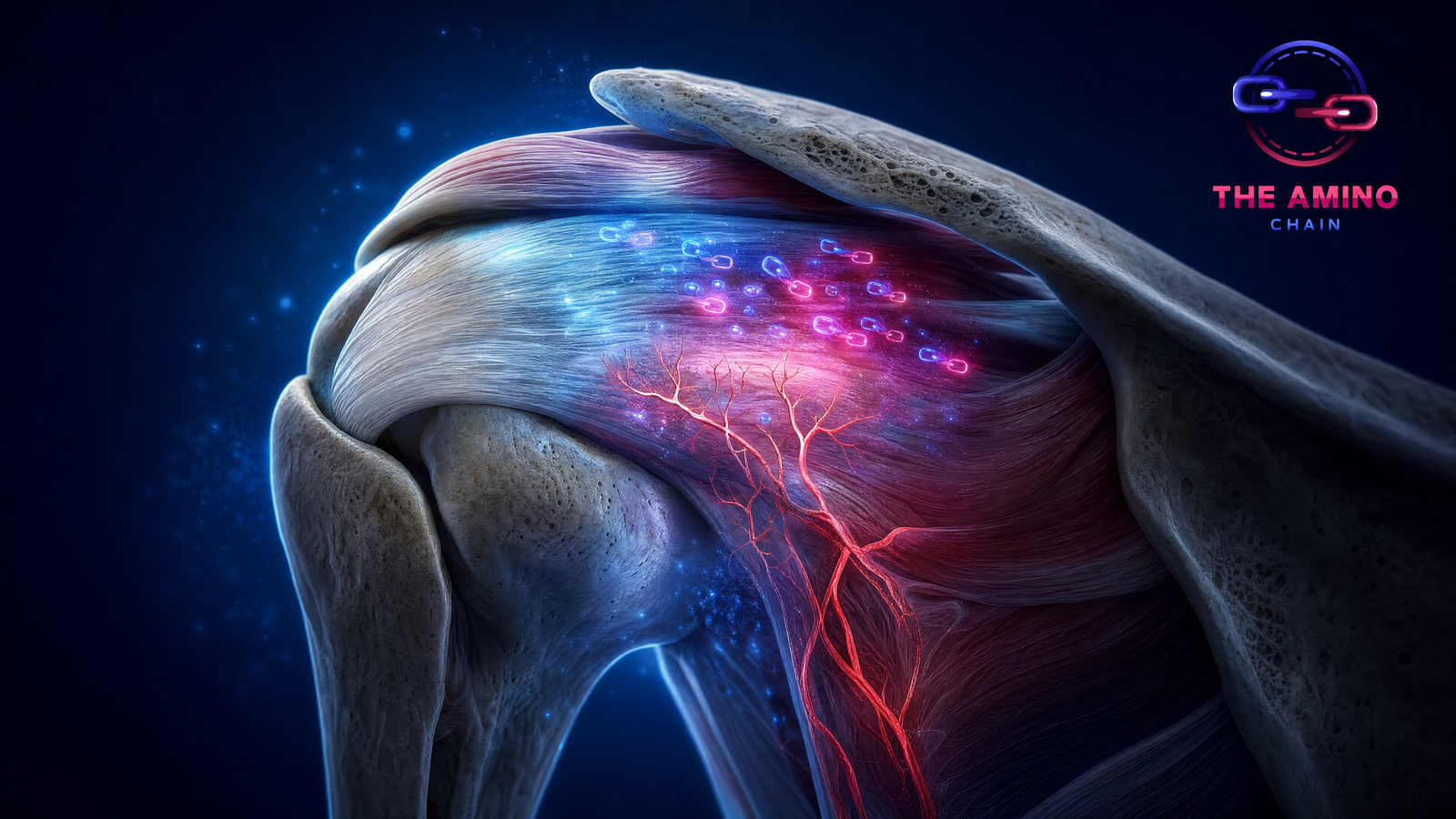
The shoulder is the most mobile joint in the human body — and that mobility comes at a cost. The rotator cuff, a group of four tendons that stabilize the shoulder, is under constant mechanical stress and is one of the most commonly injured structures in the musculoskeletal system. With rotator cuff tears affecting up to 40% of people over age 60, the search for compounds that may support tendon repair pathways has drawn significant research interest toward peptides like BPC-157 and TB-500.
Rotator Cuff Anatomy and Why It Fails
The rotator cuff consists of four muscles and their tendons: supraspinatus, infraspinatus, teres minor, and subscapularis. The supraspinatus is the most commonly injured, largely because its tendon passes through a narrow space beneath the acromion bone — a region with inherently limited blood supply.
This hypovascular zone, located approximately 1 cm from the tendon's insertion point on the humerus, is where most tears initiate. The combination of mechanical impingement, poor blood supply, and repetitive overhead movements creates a perfect storm for tendon degeneration. Unlike acute traumatic tears, most rotator cuff injuries are degenerative — the result of accumulated microtrauma over years.
The Healing Challenge
Rotator cuff tendons face the same healing challenges as other tendons — limited vascularity, constant mechanical loading, and slow tenocyte proliferation — but with additional complications. The shoulder joint's large range of motion means the healing tendon is subjected to complex multi-directional forces, not just simple tensile loading. Surgical repairs have significant re-tear rates, ranging from 20-70% depending on tear size, patient age, and tissue quality.
This high failure rate has motivated research into biological approaches that might improve the quality of tendon repair tissue — which is where peptide research becomes relevant.
BPC-157 and Tendon Biology
BPC-157's research profile in tendon repair is the most developed among research peptides. Published studies have demonstrated effects on multiple pathways relevant to rotator cuff healing.
Angiogenesis promotion through VEGF upregulation directly addresses the hypovascular zone problem. If the critical zone of the supraspinatus tendon could develop improved blood supply during healing, the biological environment for repair would be fundamentally improved. Published animal studies have consistently shown increased vascularization in BPC-157-treated healing tendons.
Growth factor receptor upregulation — particularly EGF and VEGF receptors — amplifies the tissue's responsiveness to circulating repair signals. This mechanism is particularly interesting for rotator cuff injuries because the degenerative tendon tissue often shows downregulated growth factor signaling compared to healthy tendon.
The FAK-paxillin pathway activation promotes cell adhesion and migration, essential for fibroblasts to populate the repair site and begin producing organized collagen. Published studies in Achilles tendon transection models showed not just faster healing but improved collagen fiber organization — a critical factor for mechanical strength.
TB-500 and Cellular Repair Mechanisms
TB-500's role in shoulder tendon repair research centers on its ability to promote cellular migration. The rotator cuff's hypovascular zone means that repair cells — fibroblasts, mesenchymal stem cells, inflammatory cells — have difficulty reaching the injury site in adequate numbers.
By maintaining pools of monomeric G-actin available for rapid polymerization, TB-500 facilitates the cytoskeletal reorganization that cells need to migrate. Published wound healing studies have demonstrated accelerated cellular infiltration of injured areas, with cells arriving earlier and in greater numbers.
TB-500's anti-inflammatory properties are also relevant to shoulder injuries. Chronic rotator cuff tears often develop a sustained inflammatory state in the subacromial bursa that impedes healing. Published data shows TB-500 modulates inflammatory cytokines — reducing TNF-alpha, IL-1beta, and IL-6 while supporting anti-inflammatory mediators.
The Collagen Quality Question
One of the most important aspects of rotator cuff repair is the quality of the healed tissue. Natural tendon is composed primarily of highly organized Type I collagen fibers aligned along the direction of mechanical stress. Scar tissue, by contrast, contains disorganized collagen with inferior mechanical properties.
Published BPC-157 research in tendon healing models has reported improved collagen organization in treated tissue compared to controls. This finding is potentially significant for rotator cuff repairs, where the mechanical demands on the healed tissue are extreme — supporting the weight of the arm, allowing overhead reaching, and transmitting rotational forces.
TB-500 research has shown effects on matrix metalloproteinase (MMP) activity and collagen deposition patterns, suggesting influence on the remodeling phase where initial repair tissue is reorganized into functional tendon architecture.
Complementary Mechanisms for Shoulder Recovery
The rationale for investigating BPC-157 and TB-500 together in shoulder injury contexts follows the same logic as in other tendon research: they address different bottlenecks in the repair process. BPC-157's tissue-level effects — angiogenesis, growth factor signaling, cytoprotection — create a more favorable local environment. TB-500's cellular-level effects — migration, anti-inflammatory modulation, extracellular matrix remodeling — improve the repair response within that environment.
For rotator cuff injuries specifically, BPC-157's angiogenic properties may be particularly valuable given the hypovascular zone's role in tear initiation and healing failure, while TB-500's migration-promoting effects may help overcome the barrier of poor cellular access to the repair site.
What the Research Does NOT Show
Important limitations must be acknowledged. No published studies have specifically examined BPC-157 or TB-500 in rotator cuff injury models. The tendon repair data comes primarily from Achilles tendon, patellar tendon, and medial collateral ligament models in rodents. While the fundamental biology of tendon healing is similar across anatomical sites, the rotator cuff's unique biomechanical environment means direct extrapolation requires caution.
Additionally, no human clinical trials have been published for either compound in any shoulder condition. The mechanistic rationale is compelling and the preclinical data is encouraging, but we remain in the early stages of understanding how these compounds might perform in human shoulder pathology.
Conventional Shoulder Rehabilitation
Evidence-supported approaches for rotator cuff injuries include physical therapy focusing on scapular stabilization and rotator cuff strengthening, progressive loading to improve tendon capacity, activity modification to reduce provocative movements, corticosteroid injections for pain management in acute phases (though with concerns about long-term tendon effects), and surgical repair for significant tears with functional limitations.
These approaches have decades of clinical evidence and should form the foundation of any shoulder rehabilitation program. Peptide research exists in a complementary investigational context, not as a replacement for established treatment approaches.