GHK-Cu and Hair Loss: What Research Says About Follicle Biology and Hair Growth Cycles
Hair loss affects 80 million Americans. GHK-Cu research on follicle stem cells, Wnt signaling, and dermal papilla biology offers a unique perspective on one of the most common cosmetic concerns.
Hair loss is one of the most common cosmetic concerns worldwide, affecting approximately 50 million men and 30 million women in the United States alone. Androgenetic alopecia — the most prevalent form — involves a progressive miniaturization of hair follicles driven by hormonal, genetic, and inflammatory factors. GHK-Cu's published research on dermal papilla biology, Wnt pathway signaling, and anti-inflammatory effects offers a scientifically grounded perspective on how copper peptide research intersects with hair biology.
Hair Follicle Biology: A Complex Organ
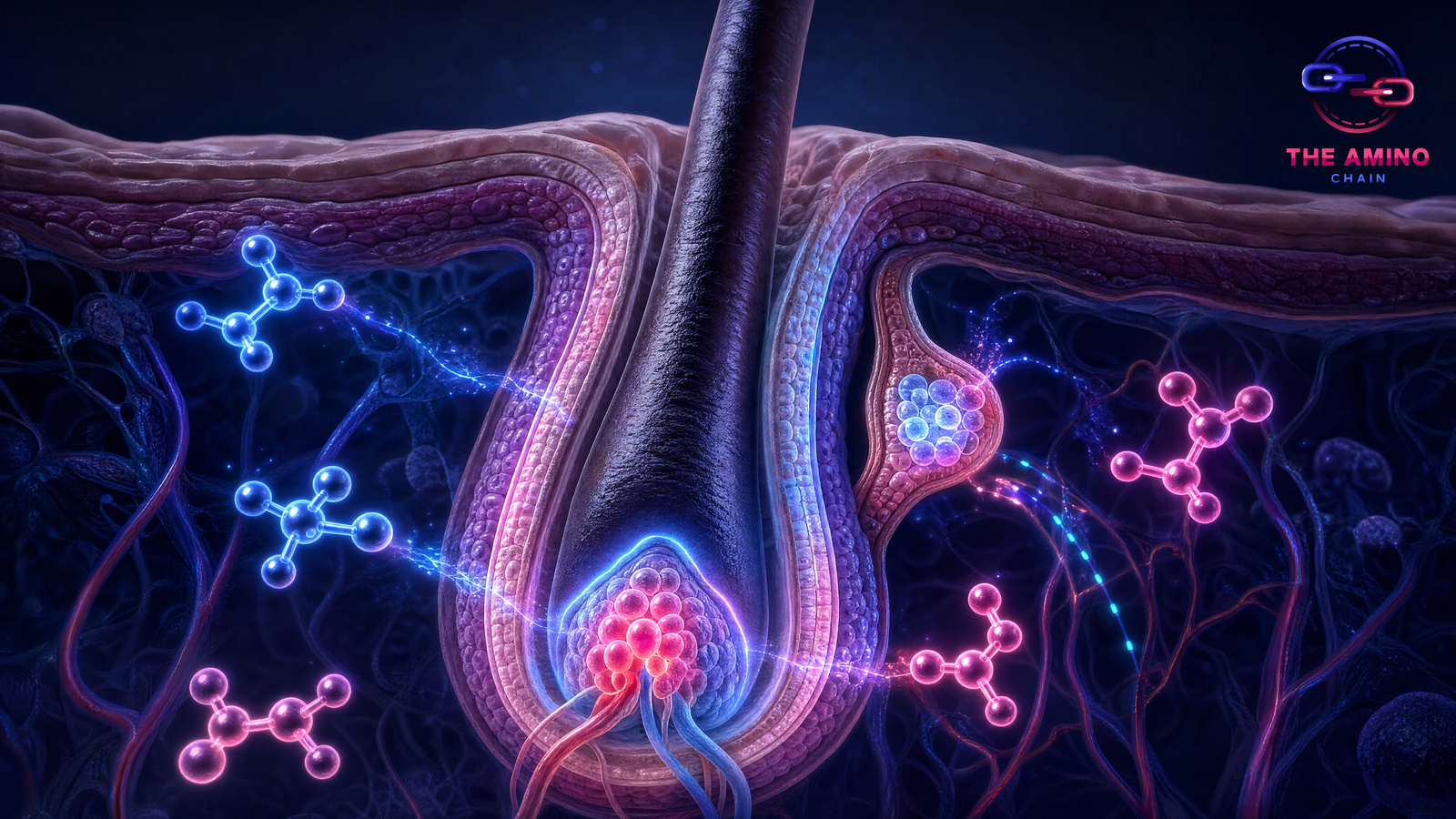
Each hair follicle is a miniature organ containing over 20 cell types, cycling through growth (anagen), regression (catagen), and rest (telogen) phases over a period of 2-7 years for scalp hair. The dermal papilla — a cluster of specialized mesenchymal cells at the base of the follicle — acts as the command center, producing growth factors that regulate follicle cycling and hair shaft production.
In androgenetic alopecia, the anagen phase progressively shortens while the telogen phase lengthens. Each successive growth cycle produces a thinner, shorter hair until the follicle produces only vellus hair — the fine, nearly invisible hairs that replace terminal (thick, pigmented) hair on the balding scalp.
GHK-Cu and Dermal Papilla Cells
The dermal papilla is the most critical structure for hair growth signaling. Published research has demonstrated that GHK-Cu influences dermal papilla cell behavior through several mechanisms relevant to hair biology.
GHK-Cu's broad gene modulatory profile — affecting over 4,000 human genes — includes genes involved in the Wnt/beta-catenin signaling pathway, which is essential for hair follicle morphogenesis and cycling. Wnt signaling activates dermal papilla cells to initiate anagen (growth phase). When Wnt signaling diminishes, follicles enter catagen and eventually telogen. Published data suggests GHK-Cu may support Wnt pathway activity, though the magnitude of this effect relative to the hormonal drivers of hair loss requires further characterization.
Copper and Hair Biology
Copper is not merely a passenger in the GHK-Cu complex — it plays specific roles in hair biology. Lysyl oxidase, a copper-dependent enzyme, is essential for crosslinking collagen and elastin in the follicle's connective tissue sheath. Without adequate copper, the structural integrity of the follicle microenvironment deteriorates.
Copper also serves as a cofactor for tyrosinase, the enzyme responsible for melanin production in hair follicle melanocytes. This connection between copper delivery and pigmentation is relevant to the graying process, though GHK-Cu's effects on hair pigmentation specifically have not been extensively published.
Superoxide dismutase (SOD) — another copper-dependent enzyme — provides antioxidant protection to follicle cells. Oxidative stress is increasingly recognized as a contributing factor to follicular miniaturization, and adequate SOD activity helps protect the metabolically active hair bulb from reactive oxygen species damage.
Anti-Inflammatory Effects on the Scalp
Inflammation plays a larger role in hair loss than many people realize. Histological studies of balding scalps consistently show perifollicular inflammation — inflammatory infiltrates around the upper follicle that may contribute to follicular miniaturization over time. This micro-inflammation damages the follicle stem cell niche in the bulge region, potentially impairing the follicle's regenerative capacity.
GHK-Cu's published anti-inflammatory properties — including modulation of inflammatory cytokines and reduction of oxidative stress markers — are relevant to this inflammatory component. By reducing perifollicular inflammation, the peptide could theoretically help preserve the follicle's stem cell compartment and support normal cycling.
Extracellular Matrix and Follicle Anchoring
The hair follicle is anchored in a complex extracellular matrix that provides structural support and biochemical signaling. GHK-Cu's well-documented stimulation of collagen, glycosaminoglycan, and proteoglycan synthesis is directly relevant to maintaining this follicular microenvironment. Degradation of the perifollicular ECM is observed in androgenetic alopecia, and supporting matrix production could help maintain the structural integrity of the follicle unit.
Research Limitations
Most GHK-Cu hair research is limited to in vitro dermal papilla cell studies and topical application studies measuring hair density and thickness. The compound's effects on the hormonal drivers of androgenetic alopecia (DHT, androgen receptor sensitivity) have not been extensively studied. GHK-Cu is unlikely to override strong genetic and hormonal hair loss patterns, but its effects on follicle microenvironment health represent a complementary research angle to conventional anti-androgen approaches.