GHRP-2 and GHRP-6: The Original Growth Hormone Releasing Peptides and Their Distinct Receptor Profiles
GHRP-2 and GHRP-6 were among the first synthetic ghrelin receptor agonists discovered. Published research reveals how they differ from each other, from Ipamorelin, and from GHRH analogs in their GH-releasing mechanisms and side effect profiles.
Growth Hormone Releasing Peptides (GHRPs) were discovered through a systematic screening approach in the 1970s-80s — researchers tested thousands of synthetic peptides for their ability to stimulate GH release from pituitary cells. GHRP-6 was identified first, followed by GHRP-2, which showed greater GH-releasing potency with a somewhat different receptor selectivity profile. Both act primarily through the ghrelin receptor (GHS-R1a) but with important differences from each other and from the highly selective Ipamorelin that followed them.
The Ghrelin Receptor Pathway
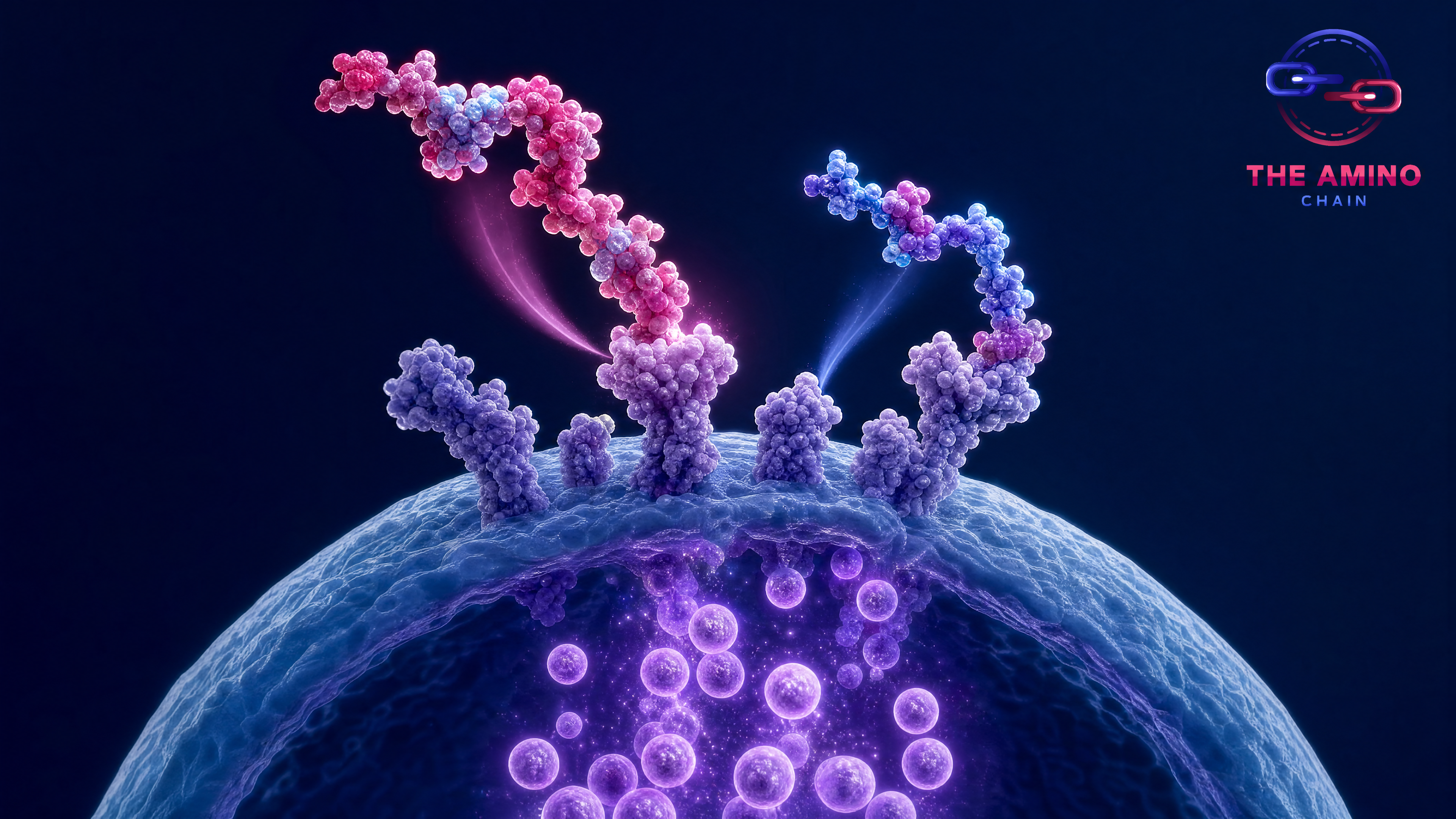
GHRPs act through the growth hormone secretagogue receptor type 1a (GHS-R1a) — the same receptor activated by the endogenous hormone ghrelin. This receptor is expressed on pituitary somatotroph cells, where its activation triggers GH release through phospholipase C and intracellular calcium signaling. This pathway is distinct from and complementary to the GHRH receptor pathway — which is why combining a GHRP with a GHRH analog (like CJC-1295) produces synergistic GH release.
GHRP-6: The First Generation
GHRP-6 (His-D-Trp-Ala-Trp-D-Phe-Lys-NH2) is a hexapeptide that produces robust GH release but with several off-target effects documented in published research. Most notably, GHRP-6 significantly stimulates appetite — an effect mediated through GHS-R1a activation in hypothalamic feeding centers (the same mechanism by which ghrelin stimulates hunger). Published studies showed GHRP-6 increased food intake by 20-30% in animal models.
GHRP-6 also stimulates cortisol and prolactin release at research doses — effects not seen with more selective compounds like Ipamorelin. The cortisol stimulation involves ACTH release from the pituitary, while prolactin release may involve direct effects on lactotroph cells. These off-target hormonal effects, while generally modest, distinguish GHRP-6 from later, more refined GH secretagogues.
GHRP-2: More Potent, Different Profile
GHRP-2 (D-Ala-D-2-Nal-Ala-Trp-D-Phe-Lys-NH2) is approximately 1.5-2 times more potent than GHRP-6 for GH release on a per-microgram basis. Published research showed GHRP-2 produces the largest GH release of any GHRP studied — exceeding both GHRP-6 and Ipamorelin. However, like GHRP-6, it stimulates appetite, cortisol, and prolactin, though the cortisol and prolactin effects are slightly less pronounced than with GHRP-6.
GHRP-2's hunger-stimulating effect is less intense than GHRP-6's but still present. For researchers where appetite stimulation is undesirable (body composition research), this is a meaningful limitation. For researchers where appetite stimulation is beneficial (recovery from illness, elderly muscle wasting), it can be advantageous.
How Ipamorelin Improved on GHRPs
Ipamorelin was developed specifically to address the off-target effects of earlier GHRPs. Published research showed Ipamorelin produces GH release comparable to GHRP-6 at optimal doses but without significant cortisol, prolactin, or appetite stimulation. This selectivity makes Ipamorelin the cleanest GH secretagogue in the GHRP class — stimulating GH with minimal off-target hormonal effects.
The selectivity difference is clinically meaningful. Cortisol elevation can impair immune function and promote catabolism. Prolactin elevation can cause gynecomastia and mood changes. Appetite stimulation complicates body composition research. Ipamorelin avoids all three, which is why it has largely replaced GHRP-2 and GHRP-6 in modern GH secretagogue protocols.
Synergy with GHRH Analogs
All three GHRPs produce synergistic GH release when combined with GHRH analogs (Sermorelin, CJC-1295, Tesamorelin). Published studies showed the combination produces 3-10 times more GH than either compound alone. The synergy reflects the complementary receptor pathways: GHRH amplifies GH pulse amplitude through cAMP signaling, while GHRPs increase pulse frequency through calcium signaling. The two pathways converge on GH granule exocytosis from different angles.
Choosing Between GHRPs
For most modern research applications, Ipamorelin's selectivity makes it the preferred GHRP. GHRP-2 may be preferred when maximum GH release magnitude is the primary goal and off-target effects are acceptable. GHRP-6 may be preferred when appetite stimulation is desired alongside GH release. All three produce qualitatively similar GH effects — the differences are in potency, selectivity, and side effect profiles.