How to Verify Peptide Purity: HPLC Testing, Mass Spectrometry, COA Analysis, and Independent Testing Options
You can't see purity with your eyes. This guide explains exactly how peptide purity is measured, how to read an HPLC chromatogram, what mass spectrometry confirms, and how to get independent testing if you don't trust a vendor's COA.
Peptide purity is the single most important quality parameter for research outcomes. An impure peptide can produce false results, adverse effects, or simply no effect at all. Yet purity is invisible — you cannot distinguish a 99% pure peptide from a 70% pure peptide by looking at the vial. The only way to verify purity is through analytical testing. This guide explains the testing methods, how to interpret results, and what options exist for independent verification.
HPLC Purity Analysis: The Primary Test
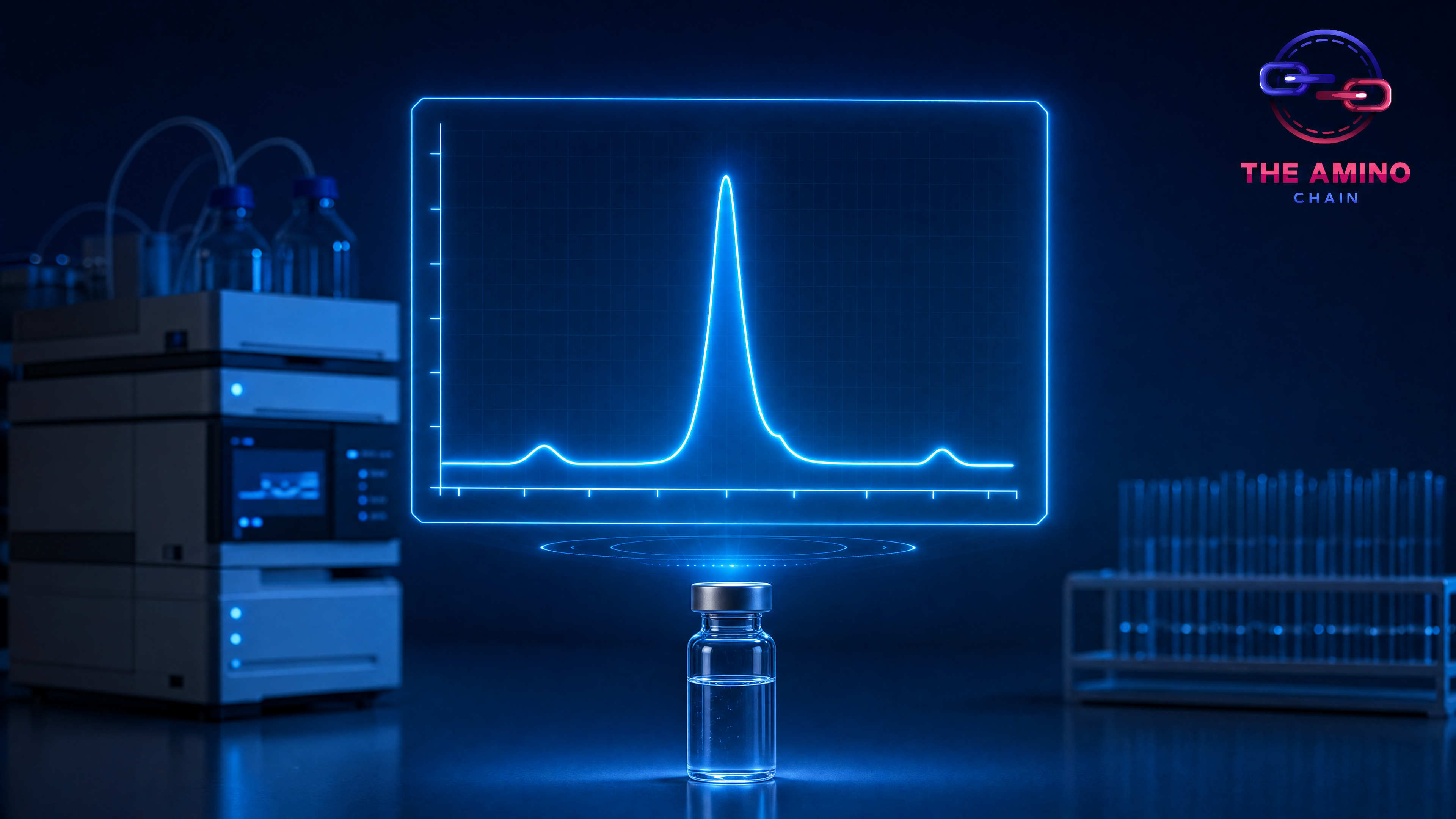
High-Performance Liquid Chromatography (HPLC) is the gold standard for peptide purity assessment. The method separates the peptide from its impurities based on hydrophobicity differences, producing a chromatogram — a graph showing peaks at different retention times. The target peptide appears as the main peak, and impurities appear as smaller peaks at different retention times.
Purity is calculated as the area of the main peak divided by the total area of all peaks, expressed as a percentage. A purity of 98% means the main peak represents 98% of the total UV-absorbing material, with the remaining 2% being impurities (deletion sequences, truncated sequences, oxidation products, or other chemical byproducts from synthesis).
What to look for on an HPLC chromatogram: a single dominant peak (the target peptide) with minimal smaller peaks. The retention time should be consistent with the expected value for that peptide. The peak should be sharp and symmetrical — broad or tailing peaks suggest purity issues. And the baseline should be clean (flat) between peaks.
Mass Spectrometry: Identity Confirmation
HPLC tells you how pure the sample is but not WHAT it is. Mass spectrometry (MS) confirms identity by measuring the molecular weight of the peptide. The measured mass is compared to the theoretical mass calculated from the amino acid sequence. If the measured mass matches the theoretical mass (within instrument tolerance, typically plus or minus 1 Da), the peptide identity is confirmed.
Common MS methods for peptides include MALDI-TOF (Matrix-Assisted Laser Desorption/Ionization - Time of Flight) and ESI-MS (Electrospray Ionization Mass Spectrometry). Both produce accurate molecular weight measurements. The COA should report both the measured mass and the theoretical (expected) mass for comparison.
Without mass spectrometry, you cannot confirm you received the correct peptide. A vial labeled "BPC-157" that passes HPLC with 99% purity could theoretically contain a different peptide that happens to be 99% pure. Mass spec eliminates this possibility.
How to Read a Certificate of Analysis
A legitimate COA should include the peptide name and sequence, batch or lot number (unique to the specific production batch), HPLC purity percentage (should be 98%+ for research grade), mass spectrometry data (measured MW matching theoretical MW), testing date, and testing laboratory identification.
Red flags on a COA: no batch number (cannot be linked to specific product), exactly round purity numbers like 99.00% (real measurements produce irregular decimals), no mass spec data (identity not confirmed), identical results across multiple batches (suggests fabricated data), no laboratory identification (cannot be independently verified), and COA appearance suggesting word processing creation rather than instrument-generated reports.
Third-Party vs First-Party Testing
First-party testing means the vendor tested their own product. While not inherently unreliable, there is an obvious conflict of interest. Third-party testing means an independent laboratory with no financial relationship to the vendor performed the analysis. Third-party testing provides stronger quality assurance because the lab has no incentive to misrepresent results.
When evaluating a vendor, ask: "Is your COA from in-house testing or third-party testing?" If third-party, ask: "Which laboratory performed the testing?" A vendor who names their testing lab is providing verifiable information. A vendor who is vague about testing methodology is a yellow flag.
Independent Testing Options
If you want to verify a vendor's claims independently, several analytical testing laboratories accept individual samples for peptide analysis. Services typically include HPLC purity analysis ($100-200 per sample), mass spectrometry identity confirmation ($100-200 per sample), and combined purity + identity panels ($200-350 per sample). Turnaround times are typically 5-10 business days.
Independent testing is most valuable when evaluating a new vendor for the first time, when research results are inconsistent with expected peptide effects, when a COA seems questionable, or when working with high-value research protocols where peptide quality is critical to outcomes.
What Purity Level Do You Need?
For most research applications, 98%+ purity is the minimum acceptable standard. Higher purity (99%+) is preferred for quantitative research where impurities could confound results. For cosmetic/topical applications, 95%+ is often acceptable because topical delivery is inherently less precise. Below 95% purity, the impurity burden becomes significant enough to potentially affect research outcomes or safety.