Matrixyl (Palmitoyl Pentapeptide-4): The Collagen-Boosting Signal Peptide Behind Modern Skincare Science
Matrixyl was the first peptide proven to stimulate collagen synthesis from outside the cell. Published research on matrikine signaling, clinical wrinkle reduction, and extracellular matrix regeneration made it the foundation of peptide skincare.
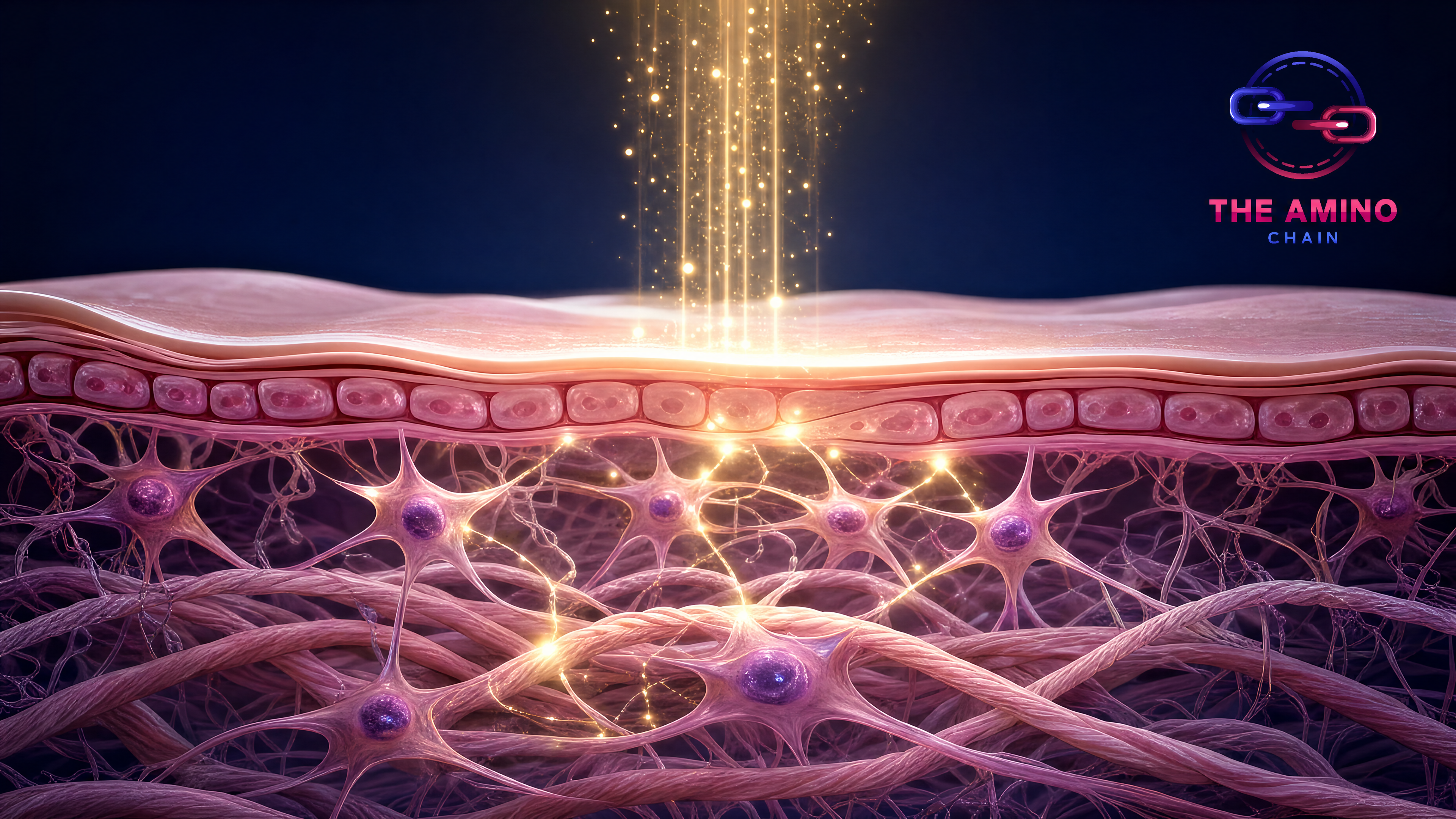
Matrixyl (Palmitoyl Pentapeptide-4, Pal-KTTKS) was a breakthrough in cosmeceutical peptide research when it was introduced by Sederma in 2000. It was the first topical peptide demonstrated in published clinical trials to stimulate collagen synthesis in human skin — not by providing raw materials for collagen production, but by mimicking the signaling fragments (matrikines) released during natural collagen turnover. This signaling mechanism — the skin's own feedback loop for matrix maintenance — represented a conceptually new approach to addressing skin aging.
The Matrikine Concept
When collagen is naturally degraded by matrix metalloproteinases (MMPs), the breakdown produces small peptide fragments called matrikines. These fragments are not mere waste products — they serve as signals to fibroblasts, communicating that matrix has been degraded and new synthesis is needed. The pentapeptide sequence KTTKS (Lys-Thr-Thr-Lys-Ser) was identified as a key matrikine fragment from type I collagen that potently stimulates new collagen and fibronectin synthesis.
Matrixyl exploits this signaling system by providing the KTTKS signal exogenously — essentially mimicking the degradation signal and triggering the fibroblast repair response without actual collagen damage having occurred. The palmitoyl (fatty acid) modification attached to the N-terminus enhances skin penetration by increasing lipophilicity, allowing the peptide to traverse the lipid-rich stratum corneum.
Mechanism of Action
Published research showed KTTKS activates fibroblast signaling through interaction with TGF-beta pathway components. The signal cascade promotes expression of type I collagen, type III collagen, and fibronectin genes. Published in vitro studies demonstrated 2-3 fold increases in collagen synthesis by dermal fibroblasts exposed to Pal-KTTKS at concentrations achievable through topical application.
Clinical Trial Evidence
Published double-blind, placebo-controlled clinical studies showed measurable improvements in skin parameters with Matrixyl use. One landmark study reported up to 68% reduction in fine line depth after 4 months of twice-daily application of a cream containing Pal-KTTKS. Other published studies confirmed improvements in skin roughness, wrinkle volume, and skin thickness as measured by optical profilometry and ultrasound.
These clinical results were significant because they demonstrated that a topical peptide could meaningfully affect dermal collagen — the structural protein located deep in the skin. Previously, topical anti-aging approaches were limited to surface effects (exfoliation, moisturization) or retinoid-mediated effects. Matrixyl opened the door to peptide-based dermal remodeling from the skin surface.
Matrixyl vs GHK-Cu for Skin
Both Matrixyl and GHK-Cu stimulate collagen synthesis, but through different mechanisms. Matrixyl mimics matrikine signaling — triggering the fibroblast's collagen synthesis program through TGF-beta pathway activation. GHK-Cu delivers copper for lysyl oxidase crosslinking, stimulates collagen through gene expression modulation, and provides antioxidant defense. The mechanisms are complementary rather than redundant, which is why many advanced skincare formulations combine both peptides.
Evolution: Matrixyl 3000 and Matrixyl Synthe'6
Sederma subsequently developed enhanced versions. Matrixyl 3000 combines Pal-KTTKS with Pal-GHK (palmitoylated GHK tripeptide), providing both matrikine signaling and GHK-mediated effects in one formulation. Matrixyl Synthe'6 (Palmitoyl Tripeptide-38) stimulates six major matrix components simultaneously: collagen I, III, and IV, fibronectin, hyaluronic acid, and laminin-5. Published research on these advanced versions showed enhanced efficacy compared to the original Matrixyl.
Limitations
Topical peptide delivery remains a challenge. The stratum corneum limits penetration, and the fraction of applied peptide reaching dermal fibroblasts is small. Published research has explored various delivery systems — liposomes, nanoparticles, microneedles — to improve dermal delivery. Results are gradual and cumulative rather than dramatic, requiring weeks to months of consistent use for measurable effects.