The Complete Guide to Peptide Dosing Calculations: Reconstitution, Concentration, and Volume Math
Peptide dosing requires precise calculations. This exhaustive guide covers reconstitution math, concentration formulas, syringe scales, unit conversions, dilution protocols, and common mistakes that waste compounds.
Peptide dosing calculations are the single most common source of confusion and error in peptide research. Every day, researchers waste expensive compounds through incorrect reconstitution volumes, miscalculated concentrations, and misread syringe markings. This guide covers everything from basic reconstitution math through advanced dilution protocols, with worked examples at every step. Bookmark this — you'll need it.
The Fundamental Formula
Every peptide dosing calculation comes back to one relationship:
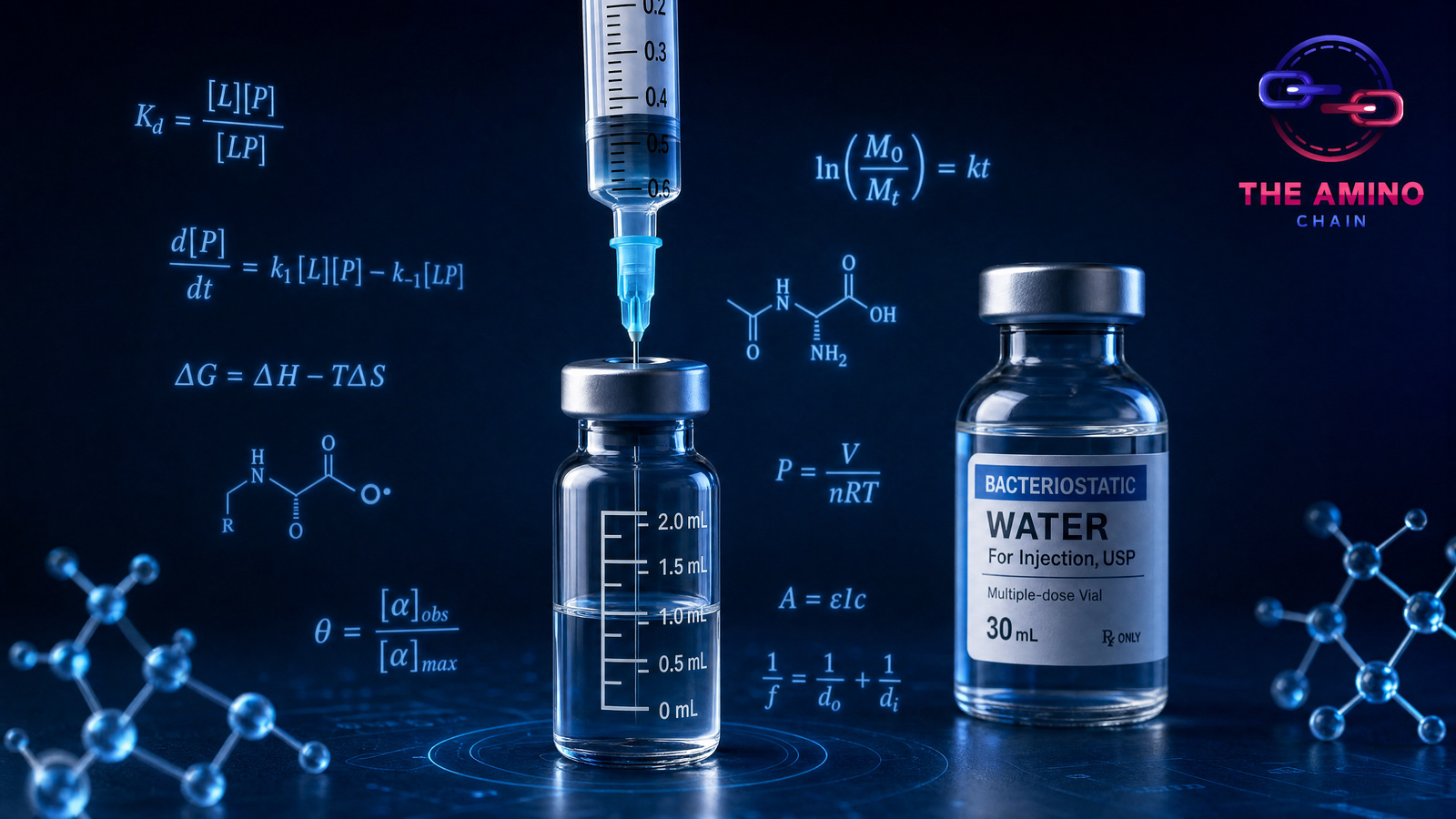
Concentration = Peptide Amount ÷ Solvent Volume
If you have 5mg of peptide and add 1mL of bacteriostatic water, your concentration is 5mg/mL. If you add 2mL of water, your concentration is 2.5mg/mL. The peptide amount is fixed (it's in the vial); the solvent volume is your choice. More water = lower concentration = larger volumes per dose. Less water = higher concentration = smaller volumes per dose.
The second formula you need:
Volume to Draw = Desired Dose ÷ Concentration
If your concentration is 5mg/mL and you want 250mcg (0.25mg), you draw: 0.25mg ÷ 5mg/mL = 0.05mL = 5 units on a U-100 insulin syringe.
Understanding Syringe Scales
Most peptide research uses U-100 insulin syringes, which are calibrated for insulin at 100 units per mL. This scale is used because it provides fine graduation marks that allow precise measurement of small volumes. On a U-100 syringe:
100 units = 1.0 mL
50 units = 0.5 mL
10 units = 0.1 mL
1 unit = 0.01 mL
The "unit" markings on insulin syringes have nothing to do with peptide dosing units — they're simply a volume scale. When someone says "draw 5 units," they mean draw to the 5 mark on the syringe, which equals 0.05mL.
Insulin syringes come in three common sizes: 100 unit (1mL), 50 unit (0.5mL), and 30 unit (0.3mL). The smaller syringes have finer graduation marks, making it easier to measure very small volumes accurately. For doses under 30 units, a 30-unit syringe provides the best precision.
Reconstitution Volume: How to Choose
The amount of bacteriostatic water you add to a peptide vial determines your concentration and therefore how much volume you'll draw for each dose. The goal is to choose a reconstitution volume that results in a convenient, easy-to-measure draw volume for your target dose.
General guidelines for choosing reconstitution volume:
For a 5mg vial: Add 1mL of BAC water → concentration of 5mg/mL (5000mcg/mL)
For a 10mg vial: Add 2mL of BAC water → concentration of 5mg/mL
For a 20mg vial: Add 2mL of BAC water → concentration of 10mg/mL
For a 30mg vial: Add 2mL of BAC water → concentration of 15mg/mL
These are starting points. You can adjust based on your target dose. The key principle: choose a volume that makes your per-dose draw volume fall between 5 and 50 units on your syringe. Below 5 units, precision suffers. Above 50 units, you're using a lot of volume per dose and the vial won't last as long.
Worked Example 1: BPC-157 (5mg vial)
Vial: 5mg lyophilized powder
Target dose: 250mcg
Step 1: Choose reconstitution volume → 1mL BAC water
Step 2: Calculate concentration → 5mg ÷ 1mL = 5mg/mL = 5000mcg/mL
Step 3: Calculate draw volume → 250mcg ÷ 5000mcg/mL = 0.05mL
Step 4: Convert to syringe units → 0.05mL × 100 = 5 units on U-100 syringe
Step 5: Calculate doses per vial → 5000mcg total ÷ 250mcg per dose = 20 doses per vial
Worked Example 2: TB-500 (5mg vial)
Vial: 5mg lyophilized powder
Target dose: 2.5mg (loading protocol)
Step 1: Reconstitute with 1mL BAC water
Step 2: Concentration = 5mg/mL
Step 3: Draw volume = 2.5mg ÷ 5mg/mL = 0.5mL
Step 4: Syringe = 50 units on U-100
Step 5: Doses per vial = 2 doses (loading)
Worked Example 3: Retatrutide (10mg vial)
Vial: 10mg lyophilized powder
Target dose: 2mg
Step 1: Reconstitute with 2mL BAC water
Step 2: Concentration = 10mg ÷ 2mL = 5mg/mL
Step 3: Draw volume = 2mg ÷ 5mg/mL = 0.4mL
Step 4: Syringe = 40 units on U-100
Step 5: Doses per vial = 10mg ÷ 2mg = 5 doses
Worked Example 4: GHK-Cu (50mg vial)
Vial: 50mg lyophilized powder
Target dose: 500mcg
Step 1: Reconstitute with 2mL BAC water
Step 2: Concentration = 50mg ÷ 2mL = 25mg/mL = 25000mcg/mL
Step 3: Draw volume = 500mcg ÷ 25000mcg/mL = 0.02mL
Step 4: Syringe = 2 units on U-100 syringe
⚠️ 2 units is very difficult to measure accurately. Consider adding more BAC water:
Alternative: Reconstitute with 5mL BAC water
Concentration = 50mg ÷ 5mL = 10mg/mL = 10000mcg/mL
Draw volume = 500mcg ÷ 10000mcg/mL = 0.05mL = 5 units ← much easier to measure
Unit Conversions
Peptide amounts use metric weight units. The conversions you need:
1mg (milligram) = 1000mcg (micrograms)
1mcg (microgram) = 0.001mg
1mL (milliliter) = 100 units on a U-100 insulin syringe
1mL = 1000 microliters (µL)
1 unit on U-100 syringe = 0.01mL = 10µL
The most common conversion error: confusing mg and mcg. A dose of 250mcg is 0.25mg — NOT 250mg. This 1000x error can be dangerous. Always double-check whether a protocol specifies milligrams or micrograms.
The Quick Reference Table Method
For frequently used vials, create a reference table and tape it to your refrigerator or lab notebook:
5mg vial + 1mL BAC water = 5mg/mL (5000mcg/mL):
100mcg = 2 units | 250mcg = 5 units | 500mcg = 10 units | 1mg = 20 units
10mg vial + 2mL BAC water = 5mg/mL (5000mcg/mL):
100mcg = 2 units | 250mcg = 5 units | 500mcg = 10 units | 1mg = 20 units | 2mg = 40 units
10mg vial + 1mL BAC water = 10mg/mL (10000mcg/mL):
250mcg = 2.5 units | 500mcg = 5 units | 1mg = 10 units | 2mg = 20 units
Aliquoting: Preserving Your Compound
Every time you puncture a vial septum, you introduce a small amount of air and potential contamination. Aliquoting — dividing your reconstituted peptide into single-use volumes immediately after reconstitution — minimizes vial penetrations and freeze-thaw cycles.
Procedure: After reconstitution, draw up individual dose volumes into separate insulin syringes. Cap each syringe, label with the date and contents, and store in the refrigerator (if using within 3-4 weeks) or freezer (for longer storage). Each syringe becomes a single-use, pre-measured dose that requires no further calculation.
Common Mistakes That Waste Compounds
Mistake 1: Injecting BAC water directly onto the lyophilized powder. This can cause aggregation and irreversible denaturation. Always add water slowly down the inside wall of the vial and let it trickle onto the powder.
Mistake 2: Shaking the vial after adding water. Shaking creates air-liquid interfaces that denature peptides. Gently swirl or roll the vial between your palms.
Mistake 3: Using the wrong syringe size. A 100-unit syringe measuring a 3-unit dose has poor precision. Use the smallest syringe that accommodates your dose volume.
Mistake 4: Not accounting for dead space. Insulin syringes have a small dead space (typically 0.5-2 units) in the needle hub that retains solution after injection. For expensive peptides, this dead space represents lost compound. Low-dead-space syringes minimize this loss.
Mistake 5: Miscounting doses remaining in a vial. Track doses on the vial label. Mark each use. When the solution becomes cloudy or shows particles, discard it regardless of calculated remaining doses.
Mistake 6: Reconstituting with too little water. Very concentrated solutions are harder to measure accurately and may exceed the solubility of some peptides, causing precipitation. If you need very small doses, use more water and draw larger, more accurate volumes.
Mistake 7: Mixing bacteriostatic water with regular sterile water. BAC water contains 0.9% benzyl alcohol that prevents bacterial growth. Plain sterile water has no preservative and becomes a contamination risk after first puncture. Always use BAC water for multi-use vials.
Multi-Peptide Calculations
If you're researching multiple peptides with different dosing schedules, create a master calculation sheet:
Compound | Vial Size | BAC Water | Concentration | Dose | Draw Volume | Units | Doses/Vial | Schedule
Fill this in once per reconstitution and reference it daily. Relying on memory for dosing calculations across multiple compounds is a recipe for errors.
When Math Gets Tricky: Dilution Protocols
Some peptides require very small doses (10-50mcg range) that are difficult to measure even with fine syringes. In these cases, a two-step dilution may be necessary:
Step 1: Reconstitute the vial normally (e.g., 5mg in 1mL = 5mg/mL)
Step 2: Draw 0.1mL (10 units) from this vial into a clean sterile vial
Step 3: Add 0.9mL of BAC water to the new vial → concentration is now 0.5mg/mL (500mcg/mL)
Step 4: From the diluted vial, 50mcg = 0.1mL = 10 units — much easier to measure
Label the diluted vial clearly with the new concentration and date. The trade-off: diluted solutions have shorter stability because the peptide is at a lower concentration where degradation can be proportionally faster.
Temperature and Timing Considerations
Allow lyophilized vials to reach room temperature before reconstituting — adding cold water to a cold vial can cause condensation that introduces moisture. After reconstitution, return the vial to refrigeration (2-8°C) promptly. Most reconstituted peptides are stable for 3-4 weeks refrigerated.
Do not freeze reconstituted peptides unless you're doing single-use aliquots. Freeze-thaw cycles form ice crystals that physically damage peptide structures. Published studies show measurable purity loss after as few as 3-5 freeze-thaw cycles.
The Calculator Shortcut
If math isn't your strength, use a peptide reconstitution calculator (we have a free one on aminoaxis.com/calculator). Enter your vial size, BAC water volume, and desired dose — it shows you exactly how many units to draw on your syringe. But understand the math first so you can verify the calculator's output and troubleshoot if needed.