Peptide Solubility: Why Some Peptides Won't Dissolve and What to Do About It
Not every peptide dissolves in bacteriostatic water. This guide covers the science of peptide solubility, how amino acid composition affects it, and the step-by-step approach to dissolving difficult compounds.
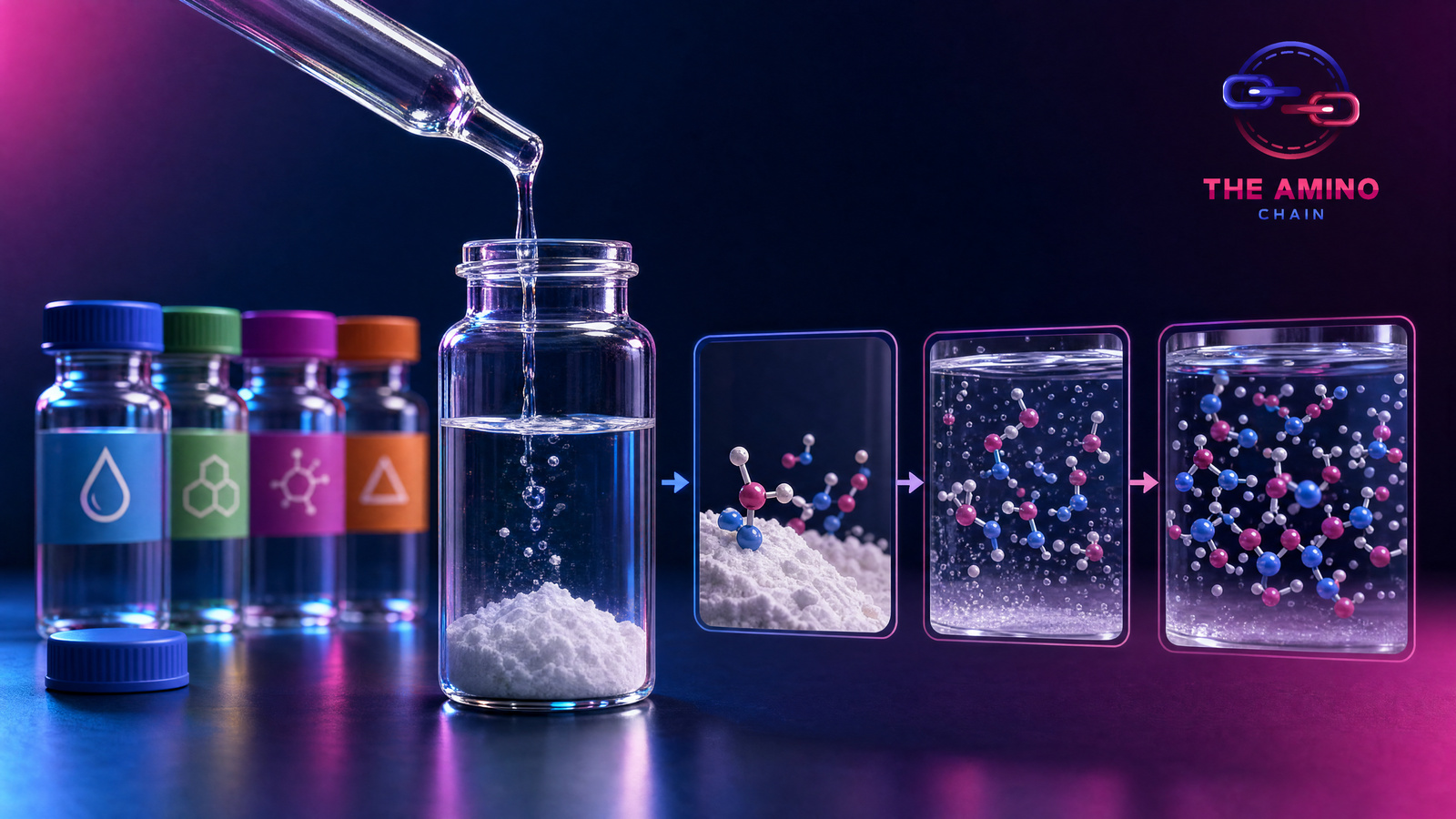
You add bacteriostatic water to a lyophilized peptide, swirl gently, wait — and nothing happens. The powder sits there, clumped at the bottom, refusing to dissolve. Before you panic or assume you received a bad product, understand that solubility is dictated by the peptide's amino acid composition, and some compounds simply require a different approach.
Why Solubility Varies Between Peptides
A peptide's solubility is determined by its amino acid sequence — specifically, the balance between hydrophilic (water-loving) and hydrophobic (water-fearing) residues. Peptides rich in charged residues like lysine, arginine, glutamic acid, and aspartic acid dissolve readily in aqueous solutions. Peptides heavy in hydrophobic residues like leucine, isoleucine, valine, phenylalanine, and tryptophan resist dissolution in water.
This isn't a defect — it's chemistry. A peptide that won't dissolve in water may be perfectly pure and structurally intact. It just needs the right solvent system.
The Solubility Decision Tree
Before reconstituting any peptide, assess its likely solubility based on its sequence characteristics. This prevents wasted compound and frustration.
If the peptide has a net positive charge (more Arg, Lys, His than Asp, Glu), try dissolving in sterile water or dilute acetic acid (0.1%). If the peptide has a net negative charge (more Asp, Glu than Arg, Lys, His), try dissolving in sterile water or dilute ammonium bicarbonate solution. If the peptide is mostly hydrophobic or has no net charge, you'll likely need an organic co-solvent.
The DMSO Rescue Protocol
When aqueous solutions fail, DMSO (dimethyl sulfoxide) is the standard rescue solvent for hydrophobic peptides. DMSO dissolves virtually all peptides because it disrupts both hydrophobic interactions and hydrogen bonds.
The protocol is straightforward: first dissolve the peptide in a small volume of neat DMSO — typically 50-100 microliters per milligram. Once fully dissolved, slowly dilute with your aqueous buffer to the desired working concentration. The key word is slowly — rapid dilution can cause the peptide to crash out of solution as the DMSO concentration drops.
Important safety note: DMSO penetrates skin rapidly and carries dissolved compounds with it. Always wear nitrile gloves and exercise appropriate caution.
Acetic Acid for Basic Peptides
Peptides with multiple basic residues (Arg, Lys) that resist dissolution in neutral water often dissolve readily in dilute acetic acid. A 0.1% acetic acid solution (approximately pH 3.5) protonates basic side chains, increasing the peptide's net positive charge and water solubility.
This approach works well for many common research peptides and avoids the complications of organic solvents. The resulting solution can typically be diluted into physiological buffers without solubility issues, provided the final peptide concentration remains reasonable.
Ammonium Bicarbonate for Acidic Peptides
Peptides rich in acidic residues (Asp, Glu) sometimes require mildly basic conditions for optimal dissolution. A 0.1 M ammonium bicarbonate solution (approximately pH 8) deprotonates acidic side chains, increasing negative charge density and improving water solubility.
Ammonium bicarbonate has the added advantage of being volatile — it decomposes to ammonia, carbon dioxide, and water during lyophilization, leaving no salt residue if you need to re-lyophilize the sample.
Sonication: When Gentle Swirling Isn't Enough
Sometimes a peptide is technically soluble in your chosen solvent but dissolves extremely slowly due to the compact structure of the lyophilized cake. Brief sonication in a bath sonicator (not a probe sonicator, which generates too much energy) can accelerate dissolution without damaging the peptide.
Limit sonication to 5-10 minute intervals. If the peptide hasn't dissolved after 30 minutes of intermittent sonication, the issue is likely true insolubility rather than slow dissolution kinetics, and you should try a different solvent approach.
Common Solubility Mistakes
The most common mistake is adding too much volume. If you add 5 mL of water to dissolve 1 mg of a poorly soluble peptide, you've created a dilute suspension that looks dissolved but actually contains undissolved microparticles. Start with the minimum volume needed, ensure complete dissolution visually, then dilute to your working concentration.
The second most common mistake is heating the solution. While warmth does increase solubility kinetics, elevated temperatures also accelerate degradation. Room temperature patience is always preferable to heated impatience.
Third, never vortex peptide solutions aggressively. The air-liquid interface created by vortexing is a high-energy environment where peptides denature and aggregate. Gentle swirling, rolling, or brief sonication are always safer mixing approaches.
Recording What Works
Once you've found a solvent system that works for a particular peptide, document it. Record the solvent, the concentration achieved, the dissolution time, and any observations about the solution (color, clarity, stability over time). This saves you from repeating the troubleshooting process with every new vial of the same compound.