Peptides and Ankle Sprains: Ligament Healing Research and Recovery Science
Ankle sprains are the most common sports injury. Up to 40% develop chronic instability. This article explores what BPC-157 and TB-500 research reveals about ligament healing biology relevant to ankle recovery.
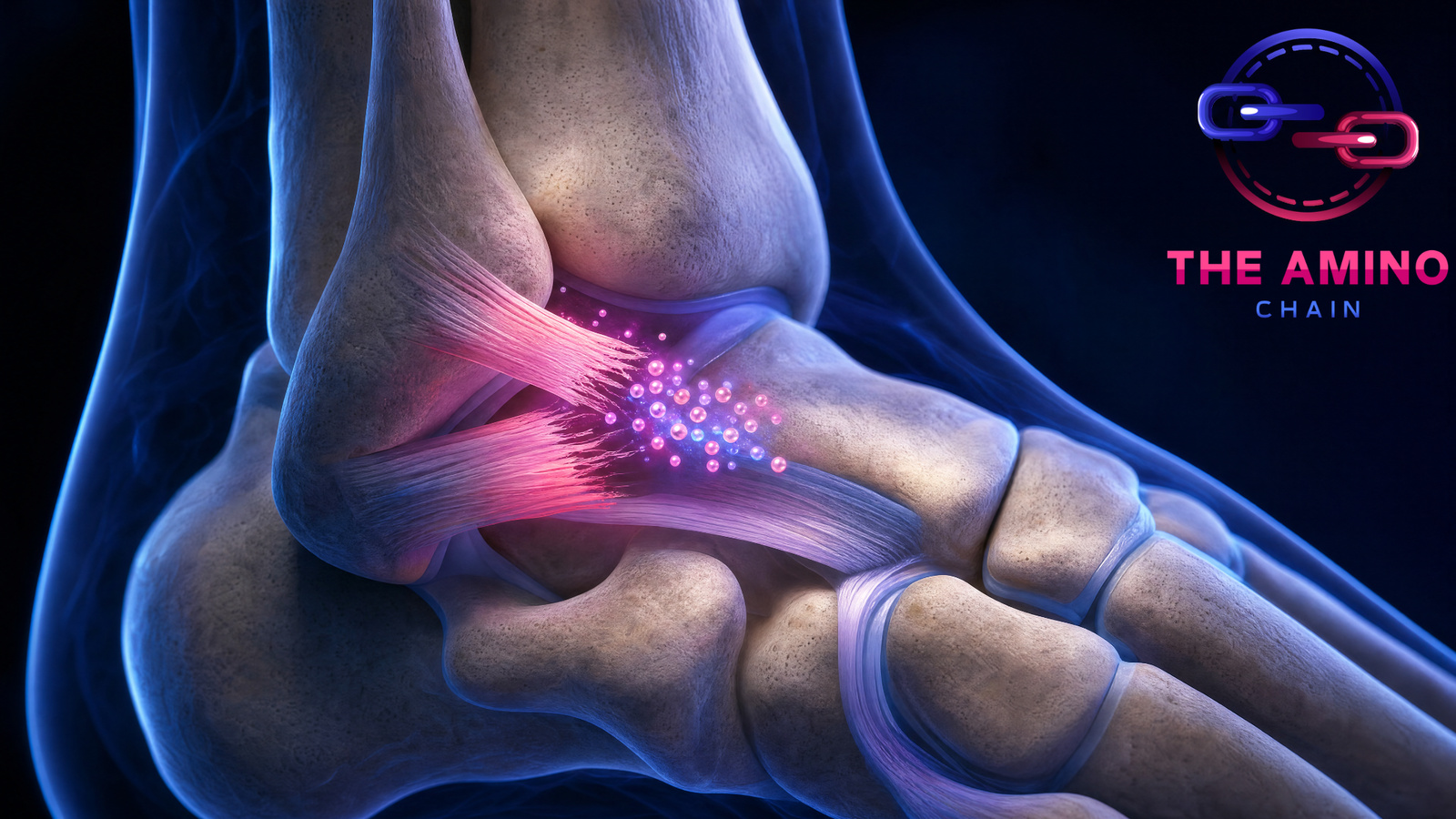
Ankle sprains account for nearly 2 million emergency department visits annually in the United States alone, making them the single most common sports injury. What's less appreciated is the long-term impact: up to 40% of individuals who sprain their ankle develop chronic ankle instability (CAI), characterized by recurrent sprains, persistent pain, and functional limitations. Understanding ligament healing biology — and where research peptides fit into that picture — is relevant to one of the most widespread musculoskeletal problems.
Ligament Biology: Why Sprains Linger
The lateral ankle ligament complex consists of three ligaments: the anterior talofibular ligament (ATFL), calcaneofibular ligament (CFL), and posterior talofibular ligament (PTFL). The ATFL is torn in approximately 85% of ankle sprains — it's the thinnest and weakest of the three, and bears the highest stress during the inversion mechanism that causes most sprains.
Ligaments heal through a three-phase process: inflammation (days 1-7), proliferation (days 7-21), and remodeling (weeks to months). However, healed ligament tissue differs fundamentally from native tissue. The repair tissue contains more type III collagen (versus the predominantly type I collagen of native ligament), has disorganized fiber architecture, and achieves only 50-70% of native ligament strength even after prolonged healing. This persistent structural deficit is a major contributor to chronic ankle instability.
BPC-157 and Ligament Repair
BPC-157 research on connective tissue healing has direct relevance to ligament biology. Published studies on the medial collateral ligament (MCL) of the knee have demonstrated accelerated healing with improved biomechanical properties in treated animals compared to controls. The MCL and ATFL share fundamental structural similarities — both are composed primarily of type I collagen, both rely on fibroblast activity for repair, and both face challenges related to collagen organization during healing.
The peptide's promotion of organized collagen deposition is particularly relevant to ankle sprains. If healed ligament tissue could achieve better collagen organization — more parallel fiber alignment, improved crosslinking, higher type I to type III collagen ratio — the mechanical properties of the repair tissue would more closely approach those of the native ligament, potentially reducing the risk of reinjury and chronic instability.
VEGF-mediated angiogenesis is relevant because ligament healing, like all connective tissue repair, requires adequate blood supply to deliver nutrients and repair cells. The ATFL's blood supply comes primarily from branches of the peroneal artery, and enhancing vascular support during the critical proliferative phase could improve healing outcomes.
TB-500 and Ankle Recovery
TB-500's promotion of cell migration is particularly relevant during the proliferative phase of ligament healing, when fibroblasts must populate the injury site and begin producing new collagen matrix. The actin regulation mechanism ensures these cells have the cytoskeletal resources to move efficiently into the damaged area.
The anti-inflammatory modulation offered by TB-500 addresses the balance between necessary inflammatory signaling and excessive inflammation that can damage surrounding tissue. Ankle sprains often involve significant swelling and bruising, reflecting a robust inflammatory response. Modulating this response toward a more controlled healing-oriented profile could theoretically optimize the inflammatory phase without eliminating it entirely.
The Chronic Instability Problem
Chronic ankle instability develops when the healed ligament tissue is insufficient to provide normal joint stability. Contributing factors include residual ligament laxity, impaired proprioception, peroneal muscle weakness, and altered movement patterns. Research addressing any of these components has potential value.
From a tissue biology perspective, improving the quality of ligament repair tissue — achieving more organized collagen, better crosslinking, and improved mechanical properties — addresses the structural foundation of the instability problem. Both BPC-157 and GHK-Cu have published data relevant to collagen quality in healing connective tissue.
Conventional Evidence-Based Treatment
Evidence-supported approaches include early mobilization and weight-bearing as tolerated, proprioceptive and balance training beginning in the subacute phase, progressive peroneal and ankle stabilizer strengthening, functional bracing during return to activity, and surgical reconstruction for severe chronic instability not responding to comprehensive rehabilitation programs.