Peptides and Back Pain: What Research Says About Disc Herniation and Spinal Recovery
Lower back pain affects 80% of adults at some point. This article examines published research on BPC-157 and TB-500 in the context of intervertebral disc biology, spinal nerve inflammation, and connective tissue repair relevant to back conditions.
Lower back pain is the single leading cause of disability worldwide, affecting approximately 80% of adults at some point in their lives. The intervertebral disc — a complex structure of collagen, water, and proteoglycans sandwiched between vertebrae — is often at the center of the problem. As research peptides like BPC-157 and TB-500 continue to attract attention for their roles in tissue repair pathways, understanding how they relate to spinal biology is increasingly relevant.
The Intervertebral Disc: A Unique Challenge
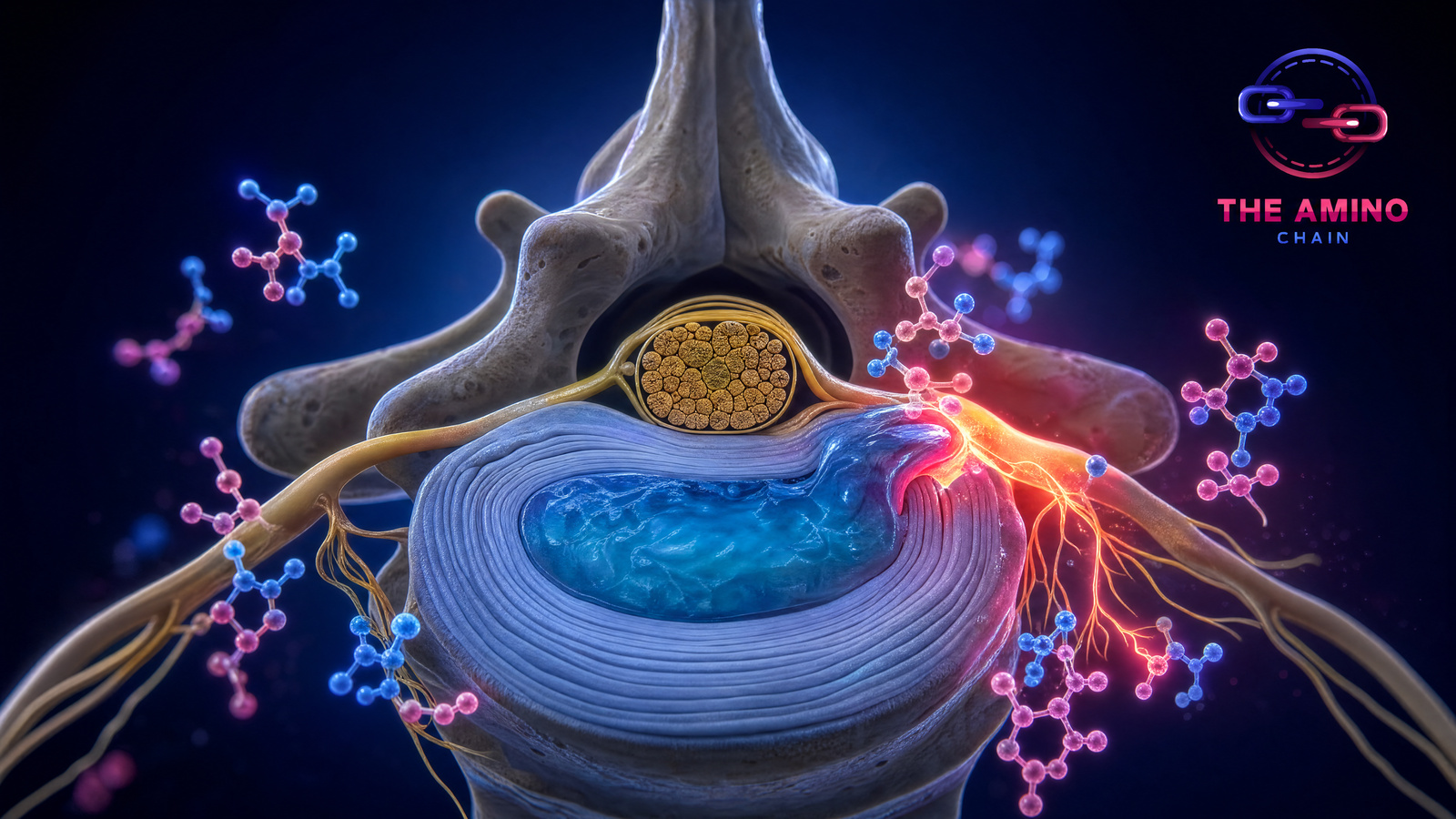
The intervertebral disc is the largest avascular structure in the human body. Its core — the nucleus pulposus — is a gel-like substance rich in water and proteoglycans, surrounded by the annulus fibrosus, concentric rings of type I and type II collagen fibers. Nutrients reach the disc primarily through diffusion from adjacent vertebral endplates, not through direct blood supply.
This avascular nature creates a fundamental healing challenge. When discs are damaged — through herniation, degeneration, or annular tears — the same limited nutrient delivery that characterizes healthy disc biology becomes a critical bottleneck for repair. Repair cells cannot easily reach the damage, and the metabolic demands of healing cannot be adequately met through diffusion alone.
Why Disc Injuries Don't Heal Well
Several biological factors conspire against disc healing. The avascular environment means inflammatory signals that normally recruit repair cells to injury sites are attenuated. The mechanical loading on spinal discs is constant and multi-directional — compression, flexion, extension, rotation — making rest virtually impossible during daily activities. And the specialized cells within the disc — chondrocyte-like cells in the nucleus pulposus — have limited proliferative capacity and slow metabolic rates.
When a disc herniates, nucleus pulposus material protrudes through a tear in the annulus fibrosus and may compress adjacent spinal nerves. The resulting pain involves both mechanical compression and chemical irritation from inflammatory mediators released by the herniated tissue.
BPC-157 and Spinal Tissue Research
BPC-157's research profile includes several mechanisms potentially relevant to spinal conditions. Published studies have demonstrated cytoprotective effects in multiple tissue systems, and the peptide's interaction with the nitric oxide system may be particularly relevant to disc biology.
Nitric oxide plays a complex role in intervertebral disc health. At physiological levels, NO supports disc cell metabolism and nutrient transport. At elevated levels — as seen in degenerative disc disease — NO becomes cytotoxic, accelerating matrix degradation and cell death. BPC-157's published bidirectional modulation of NO signaling is theoretically interesting in this context, as it may help restore NO toward physiological levels rather than simply increasing or decreasing it.
Angiogenesis promotion through VEGF upregulation is another relevant mechanism. While healthy discs are avascular, the healing process following disc injury may benefit from improved blood supply to the periphery of the disc and surrounding tissues. Published BPC-157 research has consistently demonstrated enhanced vascularization in healing connective tissue.
BPC-157 and Nerve Protection
Perhaps the most directly relevant aspect of BPC-157 research for back pain sufferers is its published neuroprotective profile. Disc herniations cause pain partly through direct nerve compression and partly through inflammatory mediator-induced nerve sensitization. Published animal studies have demonstrated BPC-157's effects on nerve healing and neural function recovery in various injury models.
The peptide has been shown to promote peripheral nerve repair in transection models, with treated animals demonstrating faster functional recovery and improved nerve conduction compared to controls. While these studies used peripheral nerve injury models rather than spinal nerve compression specifically, the underlying biology of nerve protection and repair shares common pathways.
TB-500 and Spinal Recovery
TB-500's primary mechanism — regulation of actin dynamics to facilitate cell migration — addresses one of the key bottlenecks in disc healing: getting repair cells to the injury site. The disc's avascular nature means that cells must migrate significant distances through a nutrient-poor environment to reach damaged areas.
Published research on TB-500 has demonstrated enhanced cell migration in multiple tissue contexts. The peptide maintains pools of monomeric G-actin available for rapid polymerization, enabling cells to extend pseudopods and move efficiently toward sites of tissue damage. For disc injuries, this migration-promoting effect could theoretically improve the recruitment of repair-capable cells to the annular tear or herniation site.
TB-500's anti-inflammatory properties are also relevant to back pain. Disc herniations trigger robust inflammatory responses that contribute significantly to pain and nerve sensitization. Published data shows TB-500 modulates pro-inflammatory cytokines including TNF-alpha, IL-1beta, and IL-6 — the same cytokines implicated in discogenic pain and radiculopathy.
The Role of Inflammation in Back Pain
Understanding the inflammatory component of back pain is essential for contextualizing peptide research. When nucleus pulposus material herniates and contacts surrounding tissues, it triggers an inflammatory cascade involving macrophage infiltration, cytokine release, and sensitization of nociceptive nerve fibers.
This inflammation serves both adaptive and maladaptive functions. Acutely, it initiates the healing process by recruiting immune cells and signaling for repair. Chronically, it perpetuates pain, accelerates further disc degeneration, and can cause secondary damage to adjacent spinal structures. Both BPC-157 and TB-500 have published data suggesting immunomodulatory rather than immunosuppressive effects — modulating the inflammatory response rather than eliminating it.
Conventional Approaches Remain Essential
Evidence-supported approaches for back pain include physical therapy focusing on core stabilization and movement retraining, progressive loading to build tissue capacity, ergonomic modifications to reduce provocative postures, pain education addressing central sensitization and fear-avoidance behaviors, and medical evaluation for red flags including progressive neurological deficits, bowel or bladder dysfunction, or severe unremitting pain.
The vast majority of disc herniations resolve without surgery. Published natural history studies show that 60-90% of herniated disc material is reabsorbed by the body over 6-12 months. Understanding this natural recovery process is important context for evaluating any intervention, including peptide-based approaches.
Research Limitations
No published studies have specifically examined BPC-157 or TB-500 in intervertebral disc injury models. The connections drawn here are based on shared biological pathways between disc healing and the tissue systems where these peptides have been studied. While the mechanistic rationale is logical, direct evidence in spinal models remains an area for future investigation.