Peptides and Foot Pain: What Research Says About BPC-157, TB-500, and Plantar Fasciitis
Foot pain affects millions of people worldwide, with plantar fasciitis alone impacting 1 in 10 adults. This article explores the published research on BPC-157 and TB-500 in the context of tendon and connective tissue repair relevant to common foot conditions.
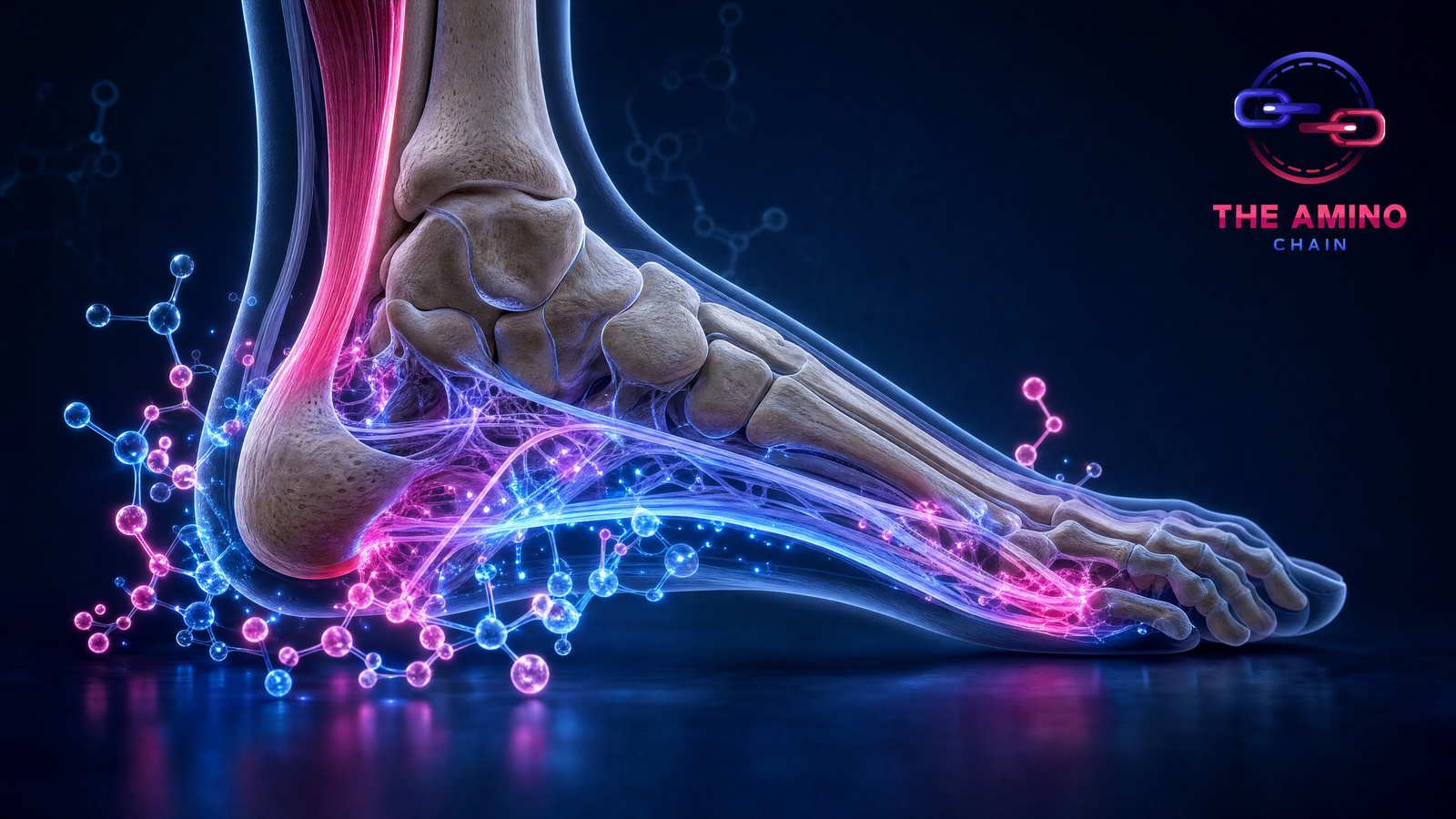
Chronic foot pain — whether from plantar fasciitis, Achilles tendinopathy, or general connective tissue degeneration — is one of the most common musculoskeletal complaints worldwide. The plantar fascia alone bears up to 14% of total foot load during walking, and when this thick band of connective tissue becomes irritated or degenerative, every step becomes a reminder. In recent years, research peptides like BPC-157 and TB-500 have attracted attention for their studied roles in tendon and connective tissue repair pathways. This article examines what the science actually tells us.
Understanding Foot Pain at the Tissue Level
Most chronic foot pain involves connective tissue — tendons, ligaments, and fascia. These structures are composed primarily of collagen fibers arranged in parallel bundles, designed to resist tensile forces. When the rate of tissue damage exceeds the rate of repair, the result is a degenerative process characterized by disorganized collagen, increased ground substance, and neovascularization (growth of abnormal blood vessels into the damaged area).
Plantar fasciitis, despite its name suggesting inflammation (-itis), is now understood to be primarily a degenerative condition — plantar fasciosis. Histological studies of surgical specimens consistently show collagen degeneration rather than inflammatory cell infiltration. This distinction matters because it shifts the research focus from anti-inflammatory approaches to tissue repair and regeneration pathways.
Why Foot Tendons Are Slow to Heal
Tendons and fascia heal slowly for several biological reasons. They have limited blood supply compared to muscle tissue, meaning fewer repair cells and nutrients reach the damaged area. The constant mechanical loading from daily walking and standing makes it difficult for healing tissue to rest and remodel. And the primary cell type in tendons — tenocytes — have relatively low metabolic activity and slow proliferation rates.
These challenges have driven research interest in compounds that might support the biological repair processes that tendons struggle to complete on their own.
BPC-157 and Tendon Repair Research
BPC-157 (Body Protection Compound-157) is a synthetic pentadecapeptide derived from a protein found in human gastric juice. Its research profile in tendon biology is among the most developed of any peptide compound.
Published studies in animal models have examined BPC-157's effects on various tendon injury models, including transected Achilles tendons and damaged medial collateral ligaments. The consistent finding across multiple research groups is accelerated functional recovery of the injured tendon, with improved biomechanical properties (increased load-to-failure and stiffness) compared to untreated controls.
Proposed Mechanisms in Tendon Repair
The published literature suggests several mechanisms through which BPC-157 may influence tendon healing. First, BPC-157 has been shown to upregulate growth factor receptors, particularly VEGF (vascular endothelial growth factor) and EGF (epidermal growth factor) receptors at the injury site. Increased VEGF signaling promotes angiogenesis — the formation of new blood vessels — which addresses one of the fundamental limitations of tendon healing: poor blood supply.
Second, BPC-157 research has demonstrated activation of the FAK-paxillin signaling pathway. This intracellular cascade is central to cell adhesion and migration — processes essential for fibroblasts and tenocytes to move into the damaged area and begin producing new collagen matrix.
Third, and perhaps most intriguingly, BPC-157 has shown interactions with the nitric oxide (NO) system. Published data suggests BPC-157 may modulate NO signaling in a bidirectional manner, potentially restoring it toward physiological levels rather than simply increasing or decreasing NO production. Since NO plays important roles in tendon healing — regulating blood flow, collagen synthesis, and inflammatory cell activity — this modulatory effect could have broad implications.
BPC-157 and Achilles Tendon Studies
The Achilles tendon is the most commonly studied tendon in BPC-157 research, and findings from these studies have direct relevance to foot pain conditions. Published rat studies using complete Achilles tendon transection models showed that BPC-157-treated animals demonstrated faster functional recovery, with the healing tendon achieving higher tensile strength at earlier timepoints compared to controls.
Histological analysis of the healing tissue revealed more organized collagen fiber arrangement in BPC-157-treated tendons — a finding that suggests not just faster healing but potentially better quality repair tissue. Disorganized collagen is a hallmark of chronic tendinopathy, so any compound that promotes organized collagen deposition is of significant research interest.
TB-500 and Connective Tissue Research
TB-500, a synthetic fragment of Thymosin Beta-4, approaches tissue repair from a different biological angle. While BPC-157 research emphasizes localized tissue effects, TB-500 research focuses on cellular migration and systemic repair signaling.
The primary mechanism of TB-500 involves regulation of actin polymerization — the process by which cells build their internal structural framework. By maintaining a pool of available monomeric actin (G-actin), TB-500 enables cells to rapidly reorganize their cytoskeleton and migrate toward sites of tissue damage.
Cell Migration and Tissue Repair
For foot conditions like plantar fasciitis, cell migration is particularly relevant. The plantar fascia, like all connective tissues, relies on fibroblasts to produce and maintain its collagen matrix. When tissue damage occurs, fibroblasts from surrounding healthy tissue must migrate into the damaged area, proliferate, and begin synthesizing new collagen.
Published research has shown that Thymosin Beta-4 promotes fibroblast migration in wound healing models. The peptide facilitates the cytoskeletal reorganization that cells need to extend pseudopods, attach to the extracellular matrix, and pull themselves forward — the basic mechanics of cell movement.
Anti-Inflammatory Modulation
While plantar fasciitis is primarily degenerative rather than inflammatory, inflammatory signaling still plays a role in the pain and progression of the condition. TB-500 has demonstrated anti-inflammatory properties in published studies, reducing production of pro-inflammatory cytokines (TNF-alpha, IL-1beta, IL-6) while supporting anti-inflammatory mediators.
This immunomodulatory profile is relevant because even in degenerative conditions, controlling the inflammatory component can reduce pain signaling and create a more favorable environment for tissue repair.
BPC-157 + TB-500: Complementary Mechanisms
Researchers studying both compounds note that their mechanisms are distinct but potentially complementary. BPC-157 appears to work primarily at the tissue level — promoting angiogenesis, upregulating growth factor receptors, and modulating NO signaling at the site of damage. TB-500 appears to work primarily at the cellular level — facilitating the migration and activity of the repair cells that actually rebuild damaged tissue.
In the context of a condition like plantar fasciitis, this complementary action could theoretically address multiple bottlenecks in the repair process simultaneously: improving blood supply to the poorly vascularized fascia (BPC-157), while enhancing the ability of fibroblasts to reach and populate the damaged area (TB-500).
The Collagen Connection
Both the plantar fascia and Achilles tendon are composed primarily of type I collagen, arranged in parallel bundles aligned along the direction of mechanical stress. In healthy tissue, this organization gives the structure its remarkable tensile strength. In degenerative conditions, this organization breaks down — collagen fibers become disorganized, cross-linking is disrupted, and the tissue loses its mechanical integrity.
Research on both BPC-157 and TB-500 has touched on collagen biology. BPC-157 studies have reported improved collagen organization in healing tendons. TB-500 research has shown effects on extracellular matrix remodeling, including modulation of matrix metalloproteinase (MMP) activity — the enzymes responsible for breaking down and remodeling collagen structures.
What About GHK-Cu?
GHK-Cu (glycyl-histidyl-lysine copper complex) deserves mention in any discussion of connective tissue research. This naturally occurring tripeptide has been shown to stimulate collagen synthesis in fibroblast cultures, with some studies reporting increases of up to 70% in collagen production. While most GHK-Cu research has focused on dermal applications, the collagen biology is fundamentally similar in tendons and fascia.
GHK-Cu's mechanism involves copper delivery to cells, where it serves as a cofactor for lysyl oxidase — the enzyme that crosslinks collagen and elastin fibers. Proper crosslinking is essential for the mechanical strength of repaired connective tissue.
Important Research Limitations
It is essential to maintain scientific rigor when discussing these compounds in relation to foot pain conditions. Several important limitations apply to the current evidence base.
First, the vast majority of tendon repair studies have been conducted in animal models — primarily rats and mice. While these models provide valuable mechanistic insights, tendons in small rodents differ from human tendons in size, loading patterns, and healing capacity. Results cannot be directly extrapolated.
Second, most published studies use acute injury models (surgical transection), while conditions like plantar fasciitis are chronic degenerative processes. The biology of acute repair and chronic degeneration overlap but are not identical.
Third, there are currently no published randomized controlled clinical trials specifically examining BPC-157 or TB-500 for plantar fasciitis or other common foot conditions in humans.
Conventional Approaches Remain Essential
Regardless of emerging peptide research, evidence-supported approaches for foot pain and plantar fasciitis include stretching of the gastrocnemius, soleus, and plantar fascia, eccentric loading exercises for Achilles tendinopathy, appropriate footwear with arch support, gradual return to activity with load management, night splints to maintain tissue length during sleep, and medical evaluation for persistent symptoms.
These conventional approaches have robust clinical evidence and should form the foundation of any approach to foot pain management.
The Future of Peptide Research in Foot Conditions
The theoretical framework connecting BPC-157 and TB-500 to connective tissue repair is supported by a growing body of preclinical evidence. The biological pathways these compounds interact with — angiogenesis, cell migration, collagen synthesis, inflammatory modulation — are precisely the pathways involved in tendon and fascia healing.
Future clinical research may help determine whether these compounds have meaningful applications in human foot conditions. Until then, they remain valuable research tools for understanding the biology of connective tissue repair — a field with significant implications for one of the most common sources of chronic musculoskeletal pain.