Peptides and Muscle Soreness: DOMS, Muscle Repair, and Recovery Research
Delayed onset muscle soreness affects everyone from beginners to elite athletes. This article examines how BPC-157 and TB-500 research relates to muscle damage, inflammation, and the recovery process.
If you've ever struggled to walk downstairs the day after a hard leg workout, you've experienced delayed onset muscle soreness (DOMS). This familiar phenomenon — peaking 24-72 hours after unaccustomed or intense exercise — represents an actual process of muscle tissue damage and repair. Understanding the biology of this damage-repair cycle provides context for why research peptides involved in tissue repair pathways have attracted interest from the sports science community.
What DOMS Actually Is
Contrary to popular belief, DOMS is not caused by lactic acid buildup. Lactic acid is cleared from muscle tissue within hours of exercise. DOMS results from microscopic structural damage to muscle fibers — specifically, disruption of the sarcomere Z-lines and damage to the extracellular matrix surrounding individual muscle fibers.
Eccentric contractions (muscle lengthening under load) cause the most damage because they generate higher forces per active motor unit than concentric contractions. This explains why running downhill produces more soreness than running uphill, and why the lowering phase of exercises tends to cause more DOMS than the lifting phase.
The Damage-Repair-Adaptation Cycle
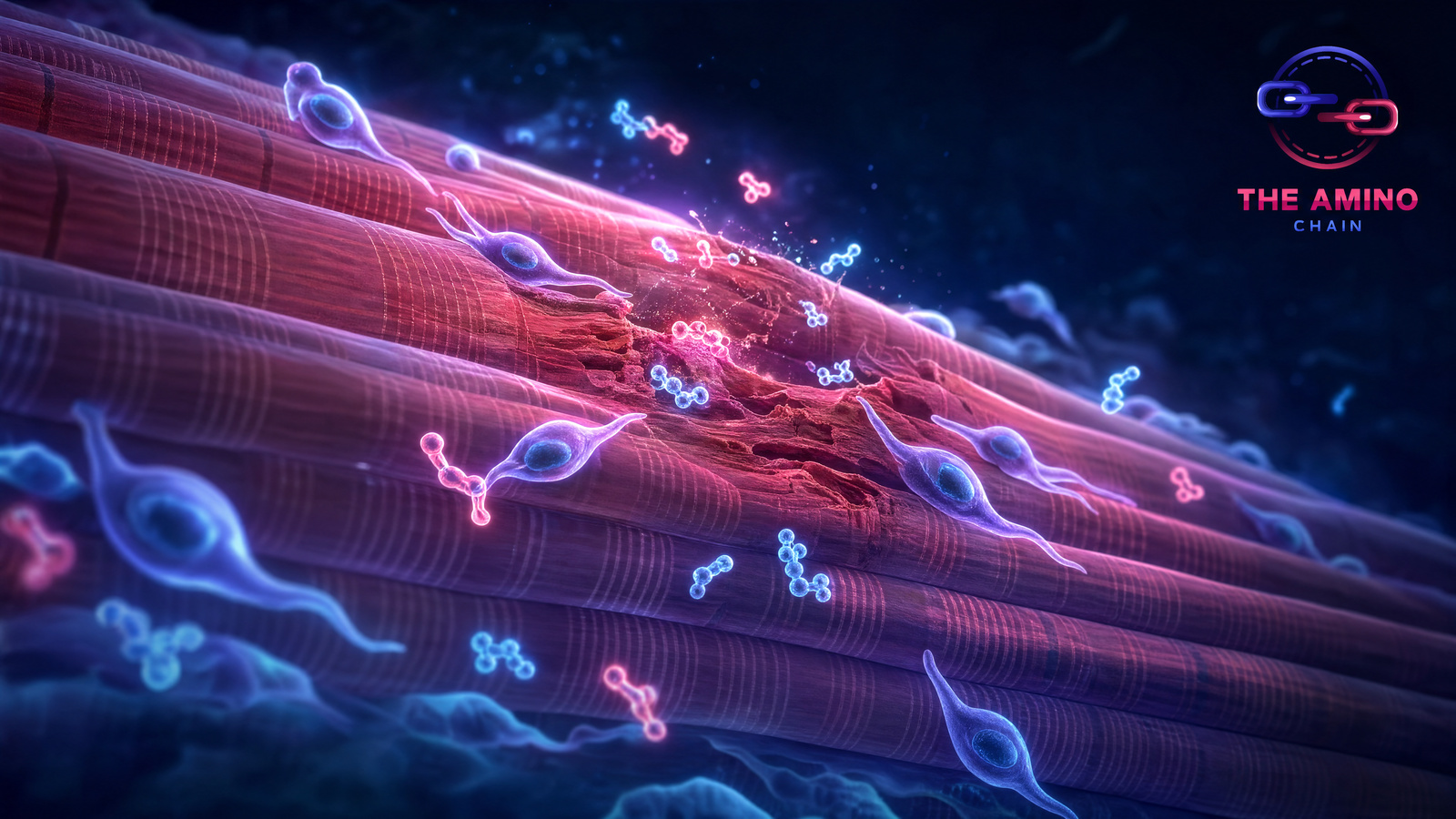
Exercise-induced muscle damage triggers a coordinated biological response. Within hours, damaged muscle fibers release intracellular contents that activate an inflammatory response. Neutrophils arrive first, followed by macrophages that clear damaged tissue and release growth factors. Satellite cells — muscle-specific stem cells — are activated, proliferate, and fuse with damaged fibers to repair and reinforce them.
This entire process takes 7-14 days, and the result is a muscle fiber that is stronger and more resistant to similar damage in the future — the repeated bout effect. Understanding this cycle is important because interventions that modulate the repair process could theoretically influence recovery speed and adaptation magnitude.
TB-500 and Muscle Biology
TB-500 has perhaps the most direct mechanistic relevance to muscle recovery. Thymosin Beta-4 is naturally present at high concentrations in muscle tissue, and published research has demonstrated its involvement in multiple aspects of muscle biology.
Satellite cell activation and migration are central to muscle repair following exercise-induced damage. TB-500's actin-sequestering function directly facilitates the cytoskeletal reorganization that satellite cells need to migrate toward damaged fibers. Published studies have shown that Thymosin Beta-4 promotes satellite cell migration and differentiation in muscle injury models.
The anti-inflammatory modulation offered by TB-500 is relevant to the inflammatory phase of muscle repair. While inflammation is necessary to clear damaged tissue and signal for repair, excessive or prolonged inflammation can delay recovery and potentially impair subsequent adaptation. TB-500's modulation of TNF-alpha, IL-1beta, and IL-6 could theoretically optimize the inflammatory phase without eliminating it.
BPC-157 and Muscle Recovery
BPC-157's published effects on tissue repair extend to muscle biology, though the majority of published studies focus on other tissue systems. The peptide's promotion of angiogenesis is relevant because exercise-induced muscle damage disrupts local capillary networks, and restoring blood supply is essential for delivering nutrients and removing metabolic waste from recovering muscle tissue.
The NO system modulation is particularly interesting for muscle recovery. Nitric oxide is a key regulator of muscle blood flow during and after exercise, and also plays a role in satellite cell activation. BPC-157's bidirectional NO modulation could theoretically support both the vascular and cellular aspects of muscle repair.
Growth factor signaling — particularly VEGF and EGF pathway activation — supports the proliferative phase of muscle repair, when satellite cells are expanding in number and preparing to fuse with damaged fibers.
Practical Recovery Context
Evidence-supported recovery strategies include adequate protein intake to supply amino acids for muscle protein synthesis, sufficient sleep for optimal growth hormone release and protein synthesis rates, progressive training programming that manages eccentric load exposure, and active recovery activities that promote blood flow without causing additional damage. These foundational strategies have robust evidence and should be the first priority for anyone seeking to optimize recovery.