Retatrutide and Liver Health: Research on NAFLD, Liver Fat, and Hepatic Metabolism
Non-alcoholic fatty liver disease affects 25% of the global population. Retatrutide's glucagon receptor activation directly targets hepatic lipid metabolism — making it one of the most mechanistically relevant compounds for liver fat research.
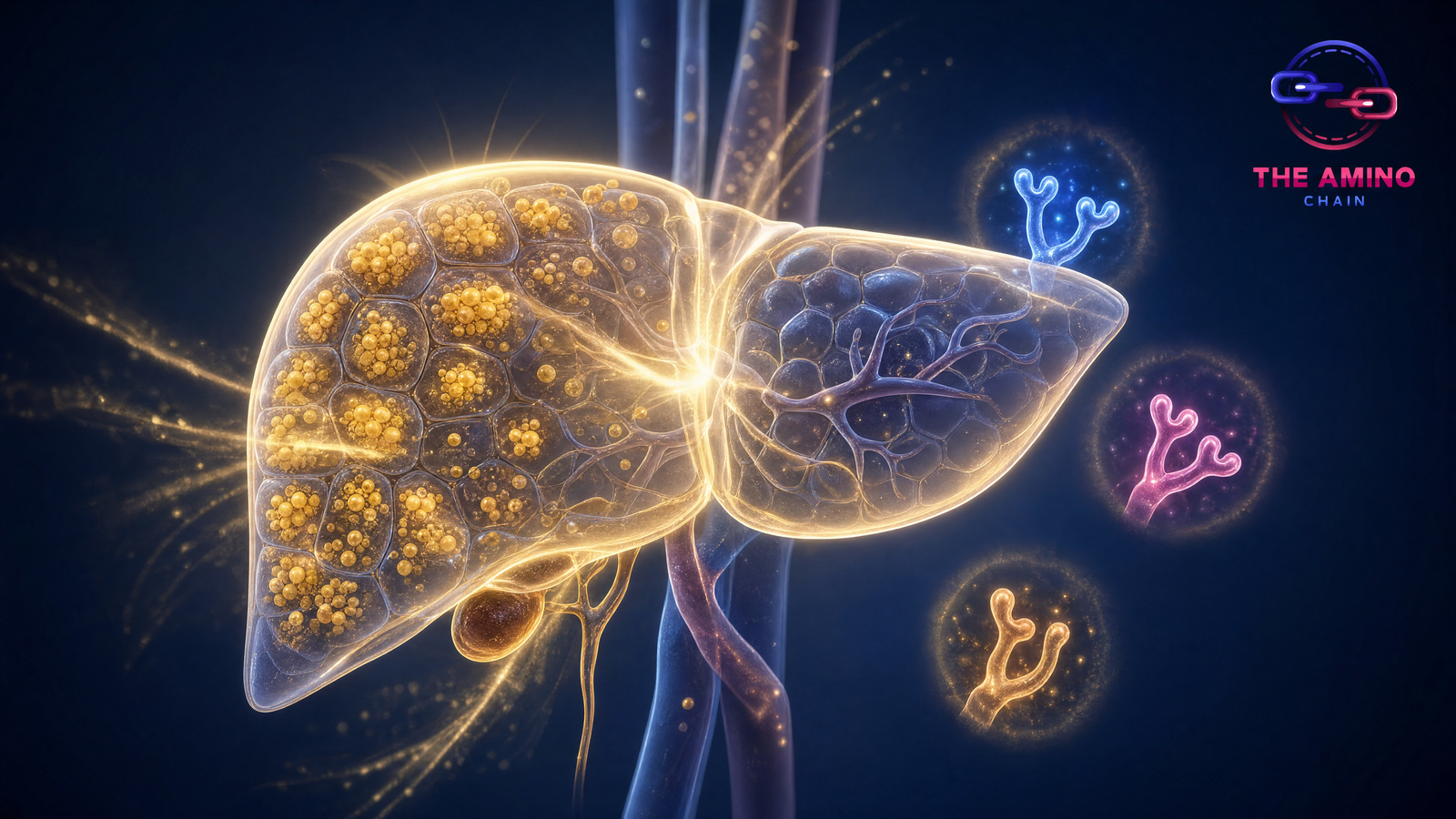
Non-alcoholic fatty liver disease (NAFLD) is a silent epidemic — affecting approximately 25% of the global population and rapidly becoming the leading cause of liver transplantation in developed countries. The condition progresses from simple steatosis (fat accumulation) to steatohepatitis (inflammation), fibrosis, and ultimately cirrhosis. Retatrutide's glucagon receptor component targets the liver's lipid handling machinery directly, making it arguably the most mechanistically relevant incretin-based compound for hepatic fat research.
The Liver Fat Problem
The liver is the body's central metabolic hub — processing nutrients from the gut, producing bile, synthesizing proteins, and managing lipid metabolism. When caloric intake chronically exceeds expenditure, excess energy is stored as triglycerides in hepatocytes. When hepatic fat content exceeds approximately 5% of liver weight, the condition is classified as hepatic steatosis — the earliest stage of NAFLD.
Hepatic steatosis is initially reversible, but sustained fat accumulation triggers inflammatory pathways, oxidative stress, and hepatocyte injury — progressing to non-alcoholic steatohepatitis (NASH). NASH is characterized by inflammation and hepatocyte ballooning, and approximately 20% of NASH cases progress to fibrosis and cirrhosis. Currently, there are limited approved pharmacological interventions specifically targeting NAFLD/NASH.
Glucagon and Hepatic Lipid Oxidation
Retatrutide's GCGR activation is uniquely relevant to liver fat because the glucagon receptor is predominantly expressed in the liver. GCGR activation directly stimulates hepatic fatty acid oxidation through several mechanisms: activation of AMPK, upregulation of CPT1 (the rate-limiting enzyme for mitochondrial fatty acid import), and increased peroxisomal beta-oxidation. The net effect is a shift in hepatic metabolism from lipid storage to lipid utilization.
Published research on GCGR agonism has consistently demonstrated reductions in hepatic triglyceride content in preclinical models of fatty liver disease. The effect is dose-dependent and mechanistically distinct from the indirect effects of weight loss on liver fat — GCGR activation directly accelerates hepatic fat clearance regardless of changes in body weight.
The Triple Advantage for Liver Research
While GCGR activation provides the most direct hepatic effect, the GLP-1R and GIPR components contribute additional mechanisms relevant to liver health. GLP-1R activation has documented anti-inflammatory effects in liver tissue, reducing hepatic expression of pro-inflammatory cytokines and potentially slowing the progression from steatosis to steatohepatitis. GIP signaling influences systemic lipid handling, potentially reducing the delivery of excess lipids to the liver.
The combination of direct hepatic fat clearance (glucagon), reduced hepatic inflammation (GLP-1), and improved systemic lipid handling (GIP) creates a multi-mechanism approach to liver fat that no single-receptor agonist can replicate.
Liver Fat Reduction in Published Research
Published studies on triple agonist peptides have reported substantial reductions in hepatic fat content as measured by MRI-proton density fat fraction (MRI-PDFF) — the gold standard non-invasive measurement of liver fat. The magnitude of liver fat reduction has been notable, with some studies reporting relative reductions exceeding 80% from baseline. These reductions exceeded those observed with GLP-1 receptor agonist comparators in head-to-head analyses.
Fibrosis and Long-Term Hepatic Outcomes
The most clinically meaningful question for NAFLD research is whether interventions can prevent or reverse hepatic fibrosis — the scarring process that ultimately leads to cirrhosis and liver failure. Fibrosis resolution requires both reduction of the underlying metabolic insult (fat accumulation and inflammation) and active remodeling of existing fibrotic tissue. Whether retatrutide's multi-receptor approach can influence fibrosis outcomes is an active area of investigation in longer-term studies.