Subcutaneous vs Intramuscular: How Administration Route Affects Peptide Research
The route of administration fundamentally affects peptide pharmacokinetics — absorption rate, bioavailability, and tissue distribution all change based on where the compound is delivered. This article examines the science behind route selection.
Where you administer a peptide matters as much as which peptide you choose. The route of administration — subcutaneous, intramuscular, intravenous, intranasal, or oral — determines how quickly the compound reaches systemic circulation, what concentration it achieves, how long it remains active, and which tissues it reaches first. For research peptides, subcutaneous and intramuscular injection are the two most common routes, and understanding their differences is essential for proper experimental design.
Subcutaneous Injection: The Default Route
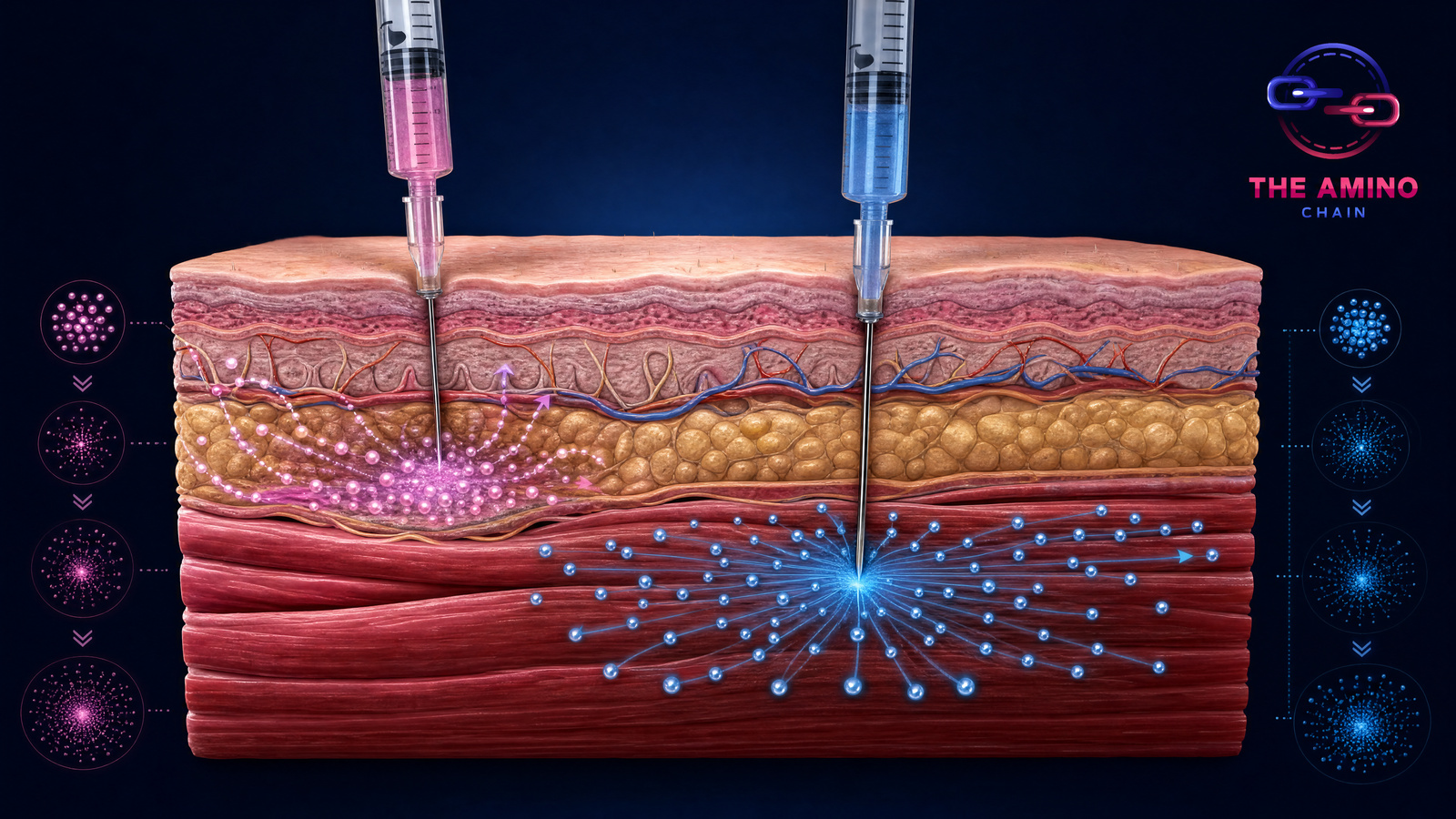
Subcutaneous (SubQ) injection delivers the compound into the fatty tissue layer between the skin and underlying muscle. This is the most common administration route for research peptides, and there are good biological reasons for this default.
Adipose tissue has moderate blood supply — enough for reliable absorption but not so much that the compound enters circulation too rapidly. This creates a depot effect: the peptide is absorbed gradually over 30-60 minutes, producing a sustained but moderate plasma concentration. For many peptides, this pharmacokinetic profile more closely mimics natural pulsatile hormone release than the rapid spike produced by IV or IM administration.
SubQ injection is also technically simpler, uses shorter needles, and accesses tissue with fewer pain receptors than intramuscular sites. For research requiring repeated daily administration, these practical factors matter.
Intramuscular Injection: Faster Absorption
Intramuscular (IM) injection delivers the compound into skeletal muscle tissue, which has significantly richer blood supply than subcutaneous fat. This results in faster absorption — typically reaching peak plasma concentration within 10-20 minutes compared to 30-60 minutes for SubQ.
The faster absorption produces a higher peak concentration but shorter duration of action compared to SubQ administration of the same compound at the same dose. This can be advantageous when a rapid, strong signal is desired, or disadvantageous when sustained, steady-state levels are the research goal.
IM injection can also accommodate larger volumes than SubQ — up to 2-3 mL in large muscle groups compared to 1-1.5 mL for comfortable SubQ injection. This is relevant when compounds must be administered at high doses in dilute solutions.
How Route Affects Specific Compounds
For BPC-157, published research has used both SubQ and intraperitoneal (IP) routes in animal models. The compound's gastric juice origin and demonstrated oral stability suggest it may have activity via multiple administration routes, including oral — unusual for peptides, which are typically degraded in the GI tract. Some researchers have investigated local versus systemic administration, with evidence suggesting that both local (near the injury site) and systemic (distant from the injury) administration produce biological effects in animal models.
For GH secretagogues like CJC-1295 and Ipamorelin, SubQ injection is the standard research route. The depot absorption profile of SubQ administration works well with these compounds' mechanisms, producing sustained receptor activation that drives GH pulsatility over hours rather than minutes.
For Selank and Semax, intranasal administration is the standard route, bypassing the blood-brain barrier via the olfactory nerve pathway. This is fundamentally different from injectable routes and highlights how administration route selection should be driven by the target tissue — in this case, the brain.
Absorption Variables
Several factors affect absorption rate regardless of route. Blood flow to the injection site is the primary determinant — exercise increases muscle blood flow and accelerates IM absorption, while cold temperatures reduce subcutaneous blood flow and slow SubQ absorption. Injection volume affects absorption: larger volumes take longer to absorb than smaller volumes at the same site.
The peptide itself matters. Molecular weight, charge, hydrophobicity, and tendency to aggregate at the injection site all influence how quickly the compound enters circulation. Larger, more hydrophobic peptides may form a local depot that absorbs over hours, while small hydrophilic peptides may be absorbed within minutes regardless of route.
Local vs Systemic Administration
For tissue repair peptides, the question of local versus systemic administration is particularly relevant. Does injecting BPC-157 near an injured knee produce better results than injecting it subcutaneously in the abdomen? The published animal data suggests that both routes produce biological effects, but the question of optimal administration for specific research goals remains an active area of investigation.
The theoretical argument for local administration is straightforward: delivering compound directly to the target tissue achieves higher local concentration with lower systemic exposure. The counter-argument is that systemic administration allows the compound to reach tissues via the bloodstream, which may be important for compounds with multiple mechanisms — BPC-157's NO modulation, for example, may have systemic effects that benefit remote tissues.
Practical Recommendations for Research
For most peptide research, SubQ injection in the abdominal area is the standard starting point. It's technically simple, reproducible, and provides consistent absorption kinetics. IM injection should be considered when faster onset, higher peak concentration, or larger injection volumes are required by the research protocol.
For tissue repair research, local administration near the target tissue is worth investigating alongside systemic administration, as the optimal route may depend on the specific compound, injury type, and research endpoint. Document injection site, volume, and timing for every administration — these variables can significantly affect results and must be controlled for reproducible research.