Where to Inject Peptides: A Visual Guide to Injection Sites for Different Compounds
Does it matter where you inject? Yes. Injection site selection affects absorption rate, comfort, and research consistency. This guide covers the best injection sites for different peptide types and research goals.
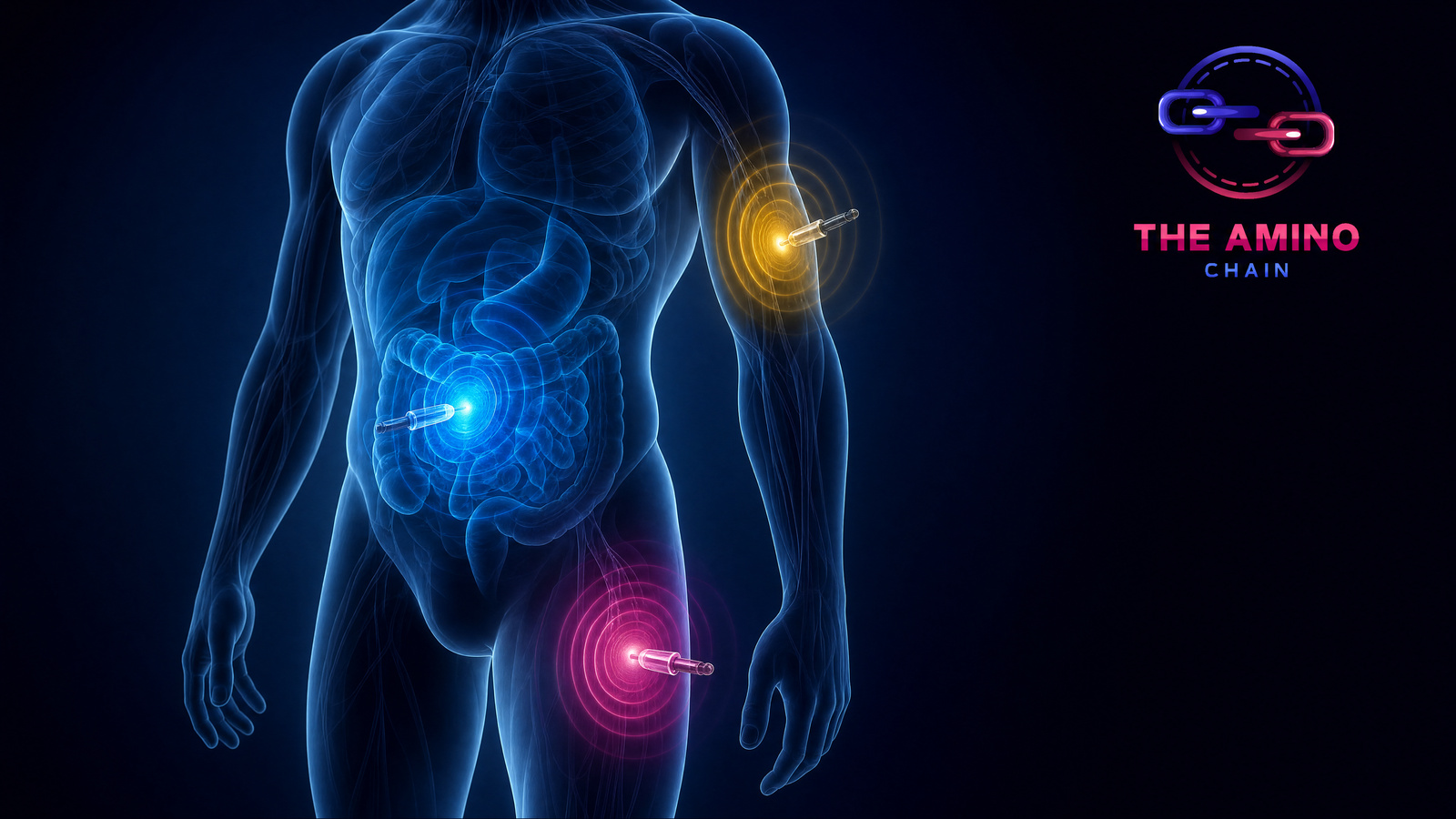
One of the most common questions in peptide research is deceptively simple: where should you inject? The answer depends on the specific peptide, the research goal, and practical considerations of comfort and consistency. Injection site selection affects absorption rate, peak concentration, bioavailability, and the reproducibility of your research protocol. This guide covers site selection principles for different peptide categories.
The Three Primary Subcutaneous Sites
For subcutaneous injection — the standard route for most research peptides — three sites are most commonly used. The abdomen is the preferred site for most researchers: it offers a large, accessible area with consistent subcutaneous fat depth and reliable absorption. Use the area around the navel, staying at least 2 inches (5 cm) away from the navel itself and avoiding the belt line.
The upper outer thigh provides an alternative site that's easy for self-administration. The injection area is the front-outer quadrant of the thigh, roughly halfway between the hip and knee. Thigh injections tend to produce slightly slower absorption compared to abdominal injections.
The back of the upper arm (posterior-lateral area between the shoulder and elbow) is a third option, though it can be difficult to access for self-injection. Some researchers use the upper arm for subcutaneous injections that benefit from somewhat slower absorption.
Site Selection for Specific Peptides
For systemic-acting peptides like BPC-157 and TB-500, abdominal subcutaneous injection is the standard choice. The abdomen provides the most consistent absorption and highest bioavailability for peptides that need to reach systemic circulation. When using these peptides for research related to a specific body area (like a knee or shoulder), some researchers choose to inject near the area of interest — though there is limited published evidence that local injection provides superior local tissue effects compared to systemic administration for these specific compounds.
For GLP-1 receptor agonist peptides (retatrutide, tirzepatide), abdominal subcutaneous injection is standard, consistent with the administration route used in published clinical research. Consistent site selection is particularly important for these compounds because absorption rate affects the pharmacokinetic profile and therefore the magnitude and timing of metabolic effects.
For GHK-Cu research focused on skin effects, both subcutaneous injection and topical application have been studied. For systemic research goals, subcutaneous injection provides more reliable and quantifiable dosing than topical application.
Site Rotation Strategy
Site rotation is essential for any repeated injection protocol. Repeated injection at the same site causes lipodystrophy — changes in the subcutaneous fat that can be either lipoatrophic (tissue loss creating a depression) or lipohypertrophic (tissue buildup creating a raised area). Both types of lipodystrophy alter absorption kinetics at that site, introducing variability into research protocols.
A practical rotation strategy divides the abdomen into quadrants (upper left, upper right, lower left, lower right) and rotates between them sequentially. Within each quadrant, individual injection sites should be spaced at least 1 inch apart. This provides dozens of distinct injection sites before repeating any location.
For protocols involving daily injections, a simple numbered system works well: assign each quadrant a number (1-4) and inject in that quadrant on the corresponding day of a 4-day cycle. Within each quadrant, move the injection point by at least 1 inch from the previous injection in that quadrant.
Proximity Injection: Evidence and Practice
The question of whether injecting near an injury site provides superior local effects compared to systemic (abdominal) injection is one of the most debated topics in peptide research. The theoretical rationale is straightforward: higher local concentrations at the target tissue might enhance effects. Some researchers inject BPC-157 subcutaneously near a knee or shoulder injury based on this reasoning.
However, published evidence specifically demonstrating superior local effects from proximity injection versus systemic injection is limited for most research peptides. The compounds studied in published research typically used systemic administration (intraperitoneal in animal studies), and the demonstrated effects occurred through systemic distribution rather than local tissue concentration.
The practical compromise many researchers adopt is alternating between proximity and systemic injection — for example, injecting near the area of interest in the morning and abdominally in the evening in a twice-daily protocol.
Intramuscular Sites
Intramuscular injection is less common for peptide research but may be preferred for certain compounds or protocols. The deltoid muscle (upper arm) is the most accessible IM site for self-injection and is appropriate for volumes up to 1mL. The vastus lateralis (outer thigh) accommodates larger volumes and is easy to access. The ventrogluteal site (hip) is the safest IM site for larger volumes but requires proper anatomical landmark identification.
IM injection produces faster absorption and higher peak concentrations compared to SubQ, which may be advantageous for peptides that benefit from pulsatile rather than sustained exposure. The trade-off is slightly more discomfort during injection and the need for longer needles (1-1.5 inches vs 1/2 inch for SubQ).
What Not to Do
Never inject intravenously unless specifically directed by a research protocol designed for IV administration. Peptide formulations intended for subcutaneous use are not suitable for IV injection. Never inject into visibly infected, inflamed, or damaged skin. Never inject through clothing. And never share needles, syringes, or multi-dose vials between individuals.